Well-water plumbing in Springtown deserves an assessment based on the property's actual water, not an assumption that every private well has the same mineral content. Calcium and magnesium can contribute to scale, while sediment, iron, or another water-quality concern may need a different treatment. A noisy heater, reduced fixture flow, and staining are useful observations, but several symptoms at once do not prove that one mineral problem explains them all. May is a practical time to gather water-test results and service records before summer demand increases. This guide explains what hardness means, how it can affect equipment, which homeowner observations are safe, and what a qualified plumber should check before recommending a softener or heater work. The aim is a property-specific maintenance plan rather than an unnecessary equipment purchase.
What "hard water" actually means on a well system
Hard water is water carrying dissolved minerals, mostly calcium and magnesium, picked up as groundwater moves through rock and soil. It is not a contamination issue and it is not dangerous to drink. It is a mechanical problem, because those dissolved minerals come out of solution and stick to things when conditions change.
Three conditions drive minerals out of solution and onto your plumbing:
- Heat. This is the big one. Heating water dramatically reduces how much mineral it can hold, which is why the inside of a water heater is where hardness does its worst work.
- Evaporation. Water sitting on a fixture, a shower door, or an aerator dries and leaves the mineral behind as a crust.
- Pressure and velocity change. Water passing through a restriction or a sharp turn drops some of its load, which is why aerators, cartridges, and valve seats scale first.
On municipal water, hardness is treated and reasonably consistent. On a private well it is whatever the geology under your property provides, it can vary with the season and the water table, and nobody is adjusting it for you. That is the practical difference for anyone on a well-fed system.
Why Springtown properties deal with this more than town lots
The city page for Springtown describes the housing pattern we work in constantly: rural homes, acreage properties, and ranches, a great many of them on private wells. Those three details change the hard water picture in ways that matter.
Private wells mean untreated mineral content. Whatever hardness the aquifer delivers is what reaches the water heater, the fixtures, and the appliances. There is no treatment step unless the property owner installed one.
Acreage means longer runs and more fixtures. A ranch property may have the house, a barn, hose bibs at several points, livestock water, and irrigation zones all fed from the same well and pressure tank. That is more pipe, more valves, and more places for scale to accumulate and restrict flow.
Ranch use means heavier and more variable demand. Filling troughs, washing equipment, and running irrigation all pull hard on a well system. High-volume draw followed by long idle periods is exactly the cycle that moves sediment around inside a system and then lets it settle somewhere inconvenient.
There is also the pressure tank and pump side of things, which town homes simply do not have. A well system has its own components with their own failure patterns, and mineral content affects those too. Well-system service is part of what we do across our service areas, and on a well property we look at the whole path from pump to fixture rather than just the fixture that is misbehaving.
Inside the water heater: where hard water does the real damage
If you only pay attention to one thing on this page, make it this section. A water heater is the single most expensive victim of hard water, and it fails quietly.
The sediment layer
Every time hard water is heated, some mineral drops out and settles to the bottom of the tank. Over years that becomes a compacted layer of sediment sitting between the heat source and the water it is supposed to heat.
On a gas heater, the burner is underneath the tank. Sediment acts as insulation, so the burner runs longer to move the water temperature, and the steel at the bottom of the tank gets hotter than it was designed to get. That accelerates tank fatigue in the exact place where a tank eventually fails.
On an electric heater, the lower heating element is usually buried in the sediment. An element packed in mineral overheats, scales over, and burns out, which is why "my water ran lukewarm and then cold" is such a common well-water complaint. Replacing that element without addressing the sediment means doing it again.
The audible signs are consistent: popping, rumbling, or a sound like gravel in a pan when the heater fires. That is water flashing to steam under the sediment layer and forcing its way out. It is not harmless noise, it is a heater telling you how thick the layer has become.
The anode rod
An anode rod is a sacrificial metal rod inside the tank whose entire job is to corrode instead of the tank's steel lining. It is the cheapest part in the appliance and the one that decides how long the appliance lasts.
Hard, mineral-rich water consumes anode rods faster. Once the rod is gone, corrosion moves to the tank itself, and a corroded tank is not a repair, it is a replacement. Checking the anode rod is not glamorous work and it is not something most homeowners think about, and that is precisely why so many well-water heaters die years earlier than they had to.
Pressure relief valves and thermostats
Mineral buildup also affects the pressure relief valve, which can scale in place and stop being able to do the one thing it exists to do. Thermostats on electric units drift when they are working against a sediment layer, which shows up as water that is too hot, not hot enough, or inconsistent between draws. Our water heater service covers heating elements, thermostats, anode rods, pressure relief valves, and sediment buildup, and on well-water properties those five things are almost always related to each other rather than separate faults.
Flushing, and being realistic about it
Flushing a tank removes loose sediment before it compacts. On hard well water, doing it more often than the once-a-year habit most people have heard of is reasonable. What flushing cannot do is remove a layer that has already hardened into a shelf at the bottom of the tank, and it cannot restore an element that has already scaled over. Flushing is prevention, not repair. Start it while the heater is healthy and it pays off for years. Start it on a ten-year-old heater that has never been touched and it may simply confirm what condition the tank is in.
What hard water does to fixtures, valves, and drains
Beyond the water heater, hardness works on the rest of the system in ways that are easy to misread.
- Aerators and showerheads clog. What feels like a pressure problem is often a screen full of mineral grit. This is the first thing to check before assuming a well pump or pressure tank issue.
- Cartridges and valve seats scale. A faucet that drips no matter how hard you close it, or a shower valve that has become stiff and gritty, is usually scaled rather than worn out.
- Angle stops and shutoff valves seize. This one matters for emergencies. A homeowner who cannot close the stop under a toilet during a failure ends up shutting off the whole house, and sometimes cannot even do that because the main has seized too. Working every shutoff valve in the house once a year is a genuinely useful habit on a well system.
- Toilet fill valves and flappers fail early. Mineral grit holds a flapper slightly open, which on a well system means the pump cycles repeatedly all night for no reason.
- Dishwashers and washing machines lose efficiency. Their inlet screens and internal valves collect the same scale.
- Drains accumulate a mineral and soap residue. Hard water and soap produce a sticky scum that coats the inside of drain lines and gives grease and hair something to hold onto, which is why the same slow drain keeps coming back.
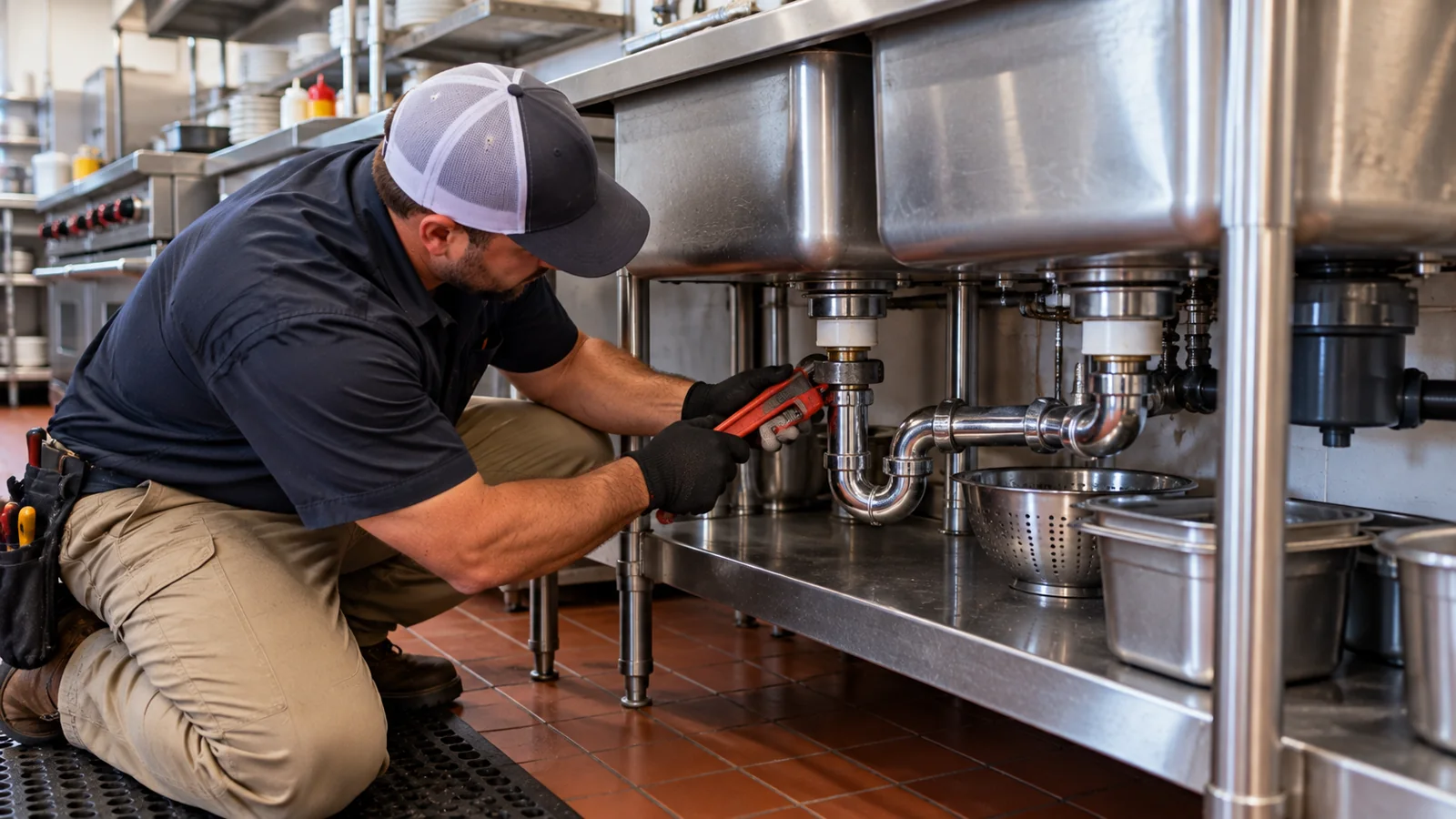
That last point is worth a moment. On hard water, drain lines narrow from the inside in a way that chemical drain products cannot address. Store-bought chemicals rarely clear a deep blockage and can corrode pipe on the way through. Mechanical clearing or hydro-jetting is what actually restores the inside diameter of the line, and a post-clean video camera inspection is what proves it worked rather than assuming. That work sits under our drain cleaning services, and on well-water properties the recurrence pattern is the tell: a drain that clogs on a schedule is a drain that was never fully cleared.
Water softeners: what they do and what they do not
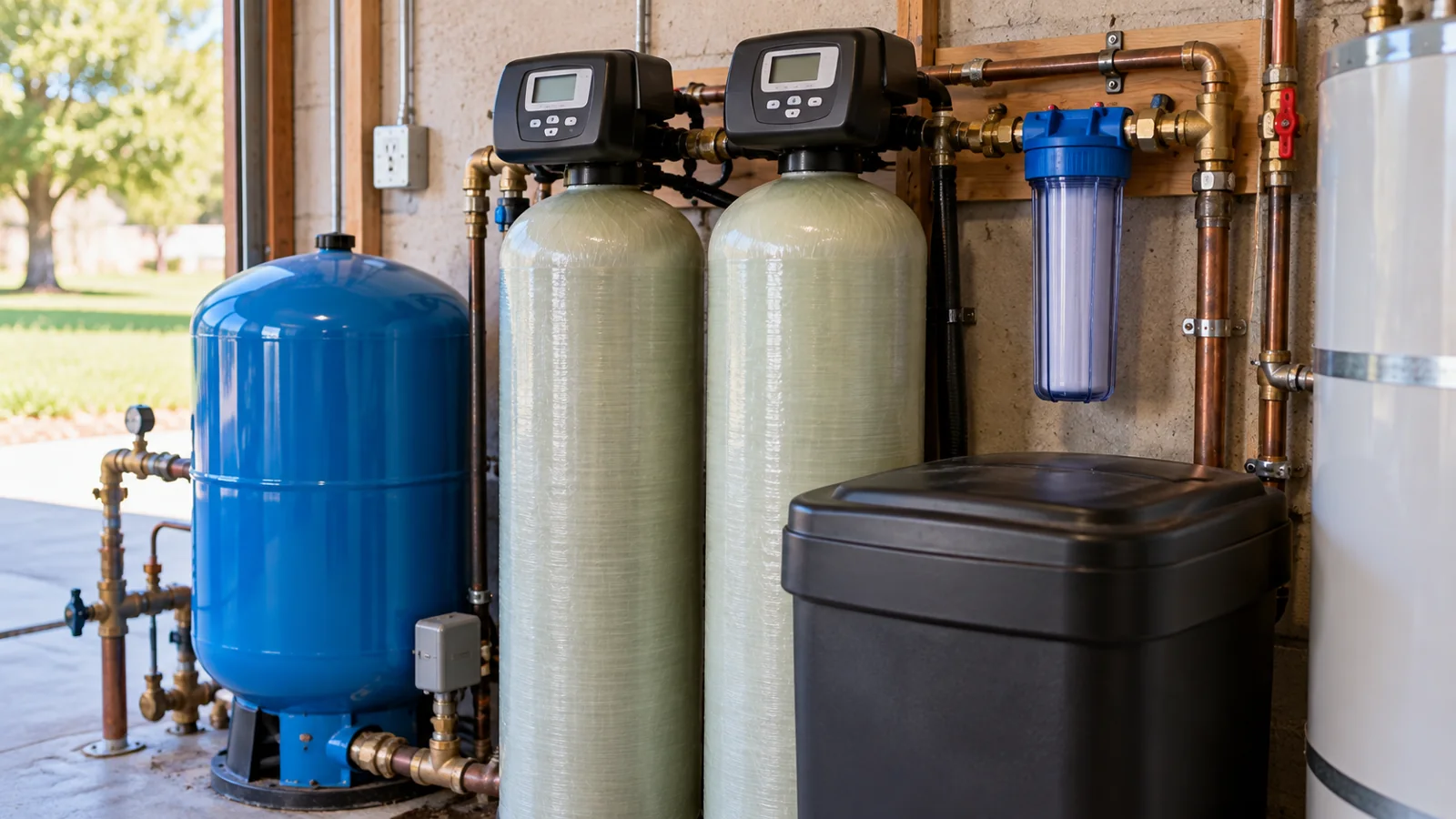
A water softener exchanges the calcium and magnesium in your water for sodium or potassium, which do not deposit scale. On a genuinely hard well supply, a properly sized and installed softener is the single most effective thing a homeowner can do, because it protects every downstream component at once instead of chasing failures one fixture at a time.
What matters in an installation:
- Sizing to the household. A softener sized for a small home on a ranch property with irrigation and livestock demand will regenerate constantly and still leave hard water reaching fixtures during peak draw.
- Placement in the line. It needs to be upstream of the water heater to protect it, and plumbed so that outdoor irrigation and livestock water can be handled sensibly rather than softened unnecessarily.
- Proper connections and a clean drain path for regeneration discharge, which on a septic property needs thought rather than a default.
- Bypass capability, so the system can be isolated for service without shutting off the house.
What a softener does not do: it is not a filter. It does not address sediment, iron staining, taste, odor, or bacteria. Those are separate problems with separate answers, and a softener installed as a catch-all for "bad well water" will disappoint. It also does not reverse existing damage. Scale already inside a heater or a drain line stays there until it is removed mechanically.
Water softener installation is part of our residential plumbing work, alongside re-pipes, fixture replacement, and the water heater work that hard water tends to create.
A spring checklist for Springtown well properties
Here is what we would walk through on an acreage property in May, roughly in order of how much trouble each item saves.
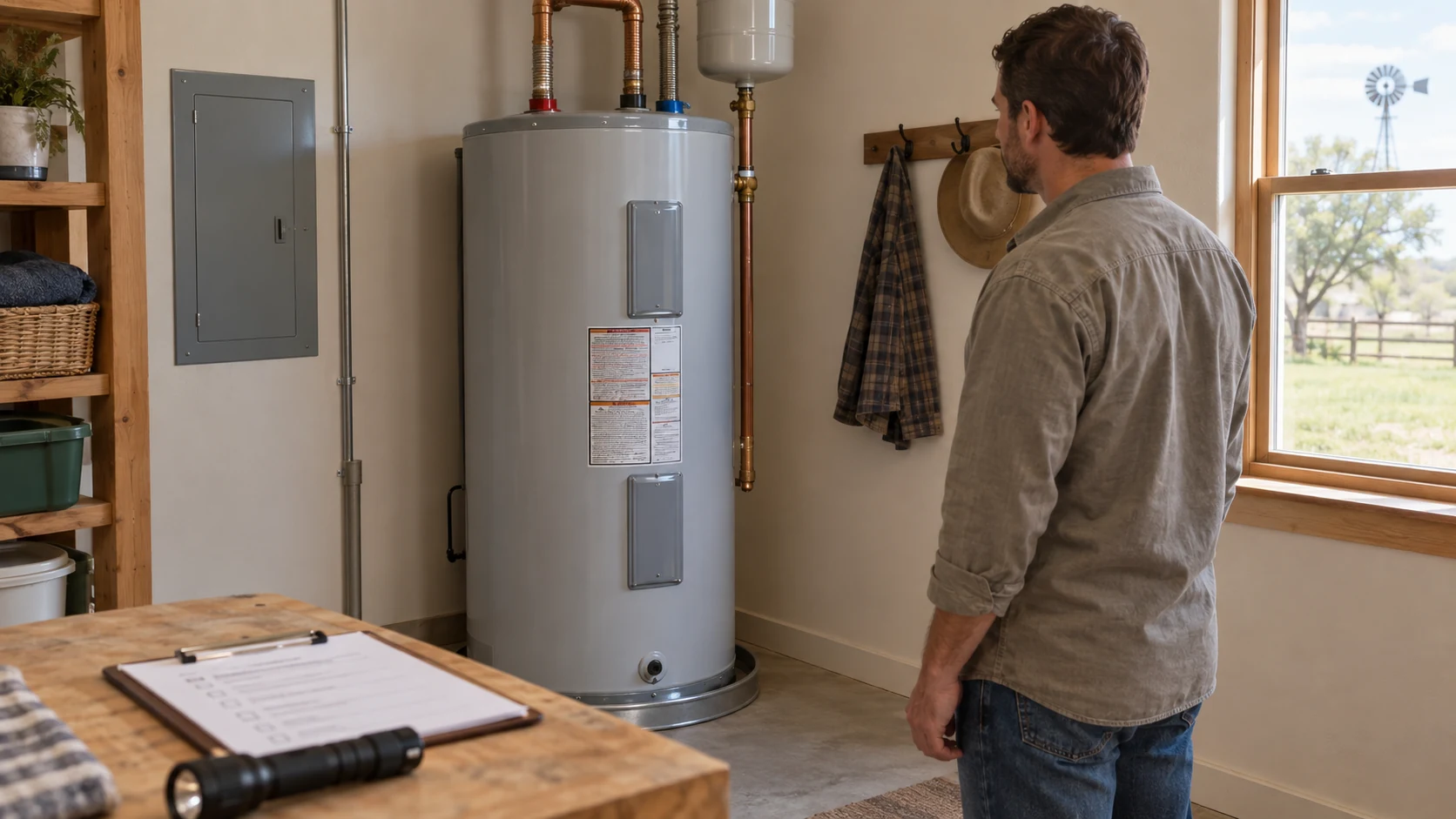
- Listen from a safe distance during a heating cycle. Note unusual popping or rumbling without treating the sound alone as a diagnosis.
- Record the heater's age and service history. A technician can assess the anode; age alone does not establish its condition.
- Look for discharge or leakage at the relief-valve outlet without touching it. Hot discharge can scald; leave valve operation and testing to a qualified technician following the manufacturer's instructions.
- Pull and rinse every aerator and showerhead. If they are packed, that is your baseline hardness telling you something.
- Locate accessible shutoff valves. Do not force a stiff or corroded valve or adjust well-system controls; arrange professional service before an urgent failure makes access harder.
- Watch for pump short-cycling. A pump that kicks on with no water running means something is leaking or a flapper is passing. On a well system this is your equivalent of a rising water bill.
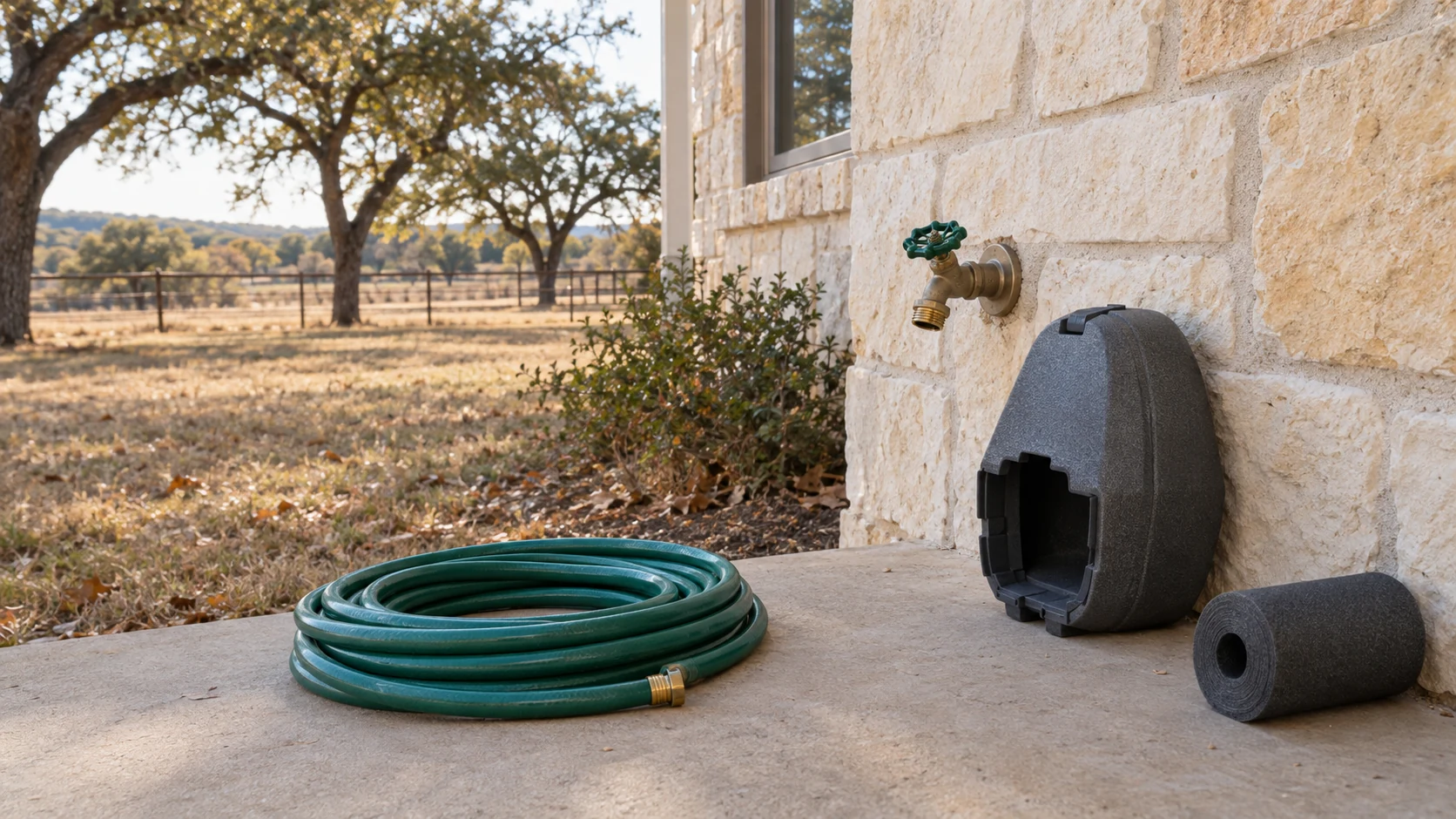
- Check hose bibs and outdoor plumbing before irrigation season starts in earnest, including the ones at barns and outbuildings that nobody looked at all winter.
- Look at the pressure tank and its gauge. Note the pressure range it is cycling between and whether it has changed.
- Note slow drains and whether several fixtures are affected. A changing pattern is useful information, not a guaranteed seasonal failure.
- Check under sinks and behind the washer for dried white crust, which marks a slow weep that dried and left its mineral behind.
Anything on that list you would rather have looked at properly, call the Weatherford office at (817) 599-8765. We offer free estimates on most non-emergency plumbing projects, so a planned softener installation or heater replacement can be scoped before any decision is made.
Repair or replace, on hard water
Hard water shifts the repair-versus-replace math, and we would rather explain why than just make a recommendation.
A repair makes sense when one component failed and the rest of the system is sound. A burned-out lower element on a five-year-old heater with a moderate sediment layer is a repair, paired with a flush and an anode rod check so the next failure is further out.
Replacement becomes the honest answer when the tank itself is compromised. A heater with a consumed anode rod, a heavy compacted sediment shelf, and a decade of hard water through it is a tank waiting to leak, and no amount of component replacement changes that. We would rather tell you that before you pay to replace parts inside a tank that is finished. When replacement is the answer, it means correct sizing for the household demand, code-compliant connections, and hauling the old unit away, and on many properties we can complete it the same day. Tankless installation is also an option worth discussing on a well system, with the caveat that hard water demands attention to scale management on any tankless unit.
For scheduling, our service hours are Monday through Saturday, 7am to 6pm, with 24/7 emergency service including weekends and holidays for the failures that do not wait. Calling the office directly is always the fastest route. More answers to common questions are on our FAQ page, and our Weatherford office at 2319 Tin Top Rd covers Springtown and the rest of Parker County.
Iron Horse Mechanical & Plumbing Services has worked these rural Parker County properties since 2014. We are locally owned, licensed and insured in Texas, and work under Texas Master Plumber License M-37011. For well-water and hard-water work in Springtown, call (817) 599-8765.
Frequently asked questions about hard water in Springtown
How do I know if my Springtown well water is hard?
The evidence is usually visible before anyone tests. White crust on aerators and showerheads, spots on glassware that will not rinse off, soap that will not lather, and a water heater that pops during a heating cycle all point to significant hardness. A test confirms the degree, which matters for sizing a softener, but the symptoms tell you the direction with fair reliability.
Will a water softener fix bad-tasting or discolored well water?
No. A softener addresses calcium and magnesium hardness, which is a scale problem, not a taste, color, odor, or sediment problem. Iron staining, sulfur smell, and particulate all need different treatment. Installing a softener and expecting it to solve everything about a well supply is the most common disappointment we see on rural properties.
How often should I flush a water heater on well water?
More often than the annual advice most people have heard, because untreated well water deposits mineral faster. Flushing removes loose sediment before it compacts into a shelf at the bottom of the tank. It will not remove a layer that has already hardened, so the habit pays off most when it starts while the heater is still relatively young and healthy.
Why does my well pump keep cycling when nothing is running?
Because something is passing water. The most common culprits are a toilet flapper held slightly open by mineral grit, a weeping angle stop, a failed pressure tank bladder, or a leak in a buried supply line out to a barn or irrigation zone. On a well system, short-cycling is the equivalent of a rising water bill: it is the system telling you water is going somewhere.
Does hard water cause clogged drains on acreage properties?
Indirectly, yes. Hard water and soap produce a sticky residue that coats the inside of drain lines, and that coating gives grease and hair something to grip. The line narrows from the inside, so the same drain slows down again and again. Mechanical clearing or hydro-jetting restores the actual diameter, and a camera check afterward confirms it.
Should I choose tankless if I am on a private well in Parker County?
Tankless can work well on a well system, but hard water requires attention to scale management, because scale inside a heat exchanger has nowhere to settle harmlessly. The decision depends on your household's peak demand, incoming water temperature, and how the property is plumbed. We will walk through tank versus tankless for your specific setup rather than push one option.
Topics