Water heater maintenance on well water in Millsap starts with the water in your own home, not an assumption about every private well in Parker County. Sediment, mineral scale, changing hot-water performance, and the condition of a tank's protective anode can all affect the maintenance conversation. They do not, by themselves, prove that a heater needs replacement. The useful first step is to gather the heater's model, service history, symptoms, and any water-test results before choosing a repair.
September is a practical time to review that information and arrange service before your household depends on the heater through colder weather. This guide explains what you can observe safely, what belongs with a qualified technician, and how to compare maintenance with replacement. It is not a set of instructions for opening a pressurized tank, changing gas controls, or working on energized electrical parts.
What Well Water Means for a Millsap Water Heater
Private wells do not all produce the same water, and a municipal supply is not automatically soft. Hardness refers mainly to dissolved calcium and magnesium, as explained in the USGS guide to water hardness. A water sample is more useful than assuming a particular result because the property has a well.
Separate three questions when discussing your system. Does the water contain dissolved minerals that can form scale? Does the plumbing receive particles that settle or collect in equipment? Are there other water-quality concerns, such as an odor or staining, that require their own evaluation? One treatment device may not address all three.
Keep the distinction between appearance and safety clear. Clear water is not proof that water is safe to drink, and a maintenance inspection of a heater is not a laboratory water-quality test. If the taste, smell, or color of your well water changes, ask the appropriate water-testing professional which tests are needed for your property.
For a service visit, find the most recent test report if you have one. Note whether it was collected before or after a softener or filter, when the sample was taken, and whether treatment equipment has changed since then. A result from a neighbor's well cannot substitute for a sample from your own supply.
Sediment, Scale, and Changes in Hot-Water Performance
Sediment and scale are often discussed together, but they are not identical. Loose material may collect in a tank, while mineral deposits can adhere to heated surfaces. The distinction matters because draining water from a heater does not necessarily remove deposits bonded to its internal surfaces.
In a gas storage heater, deposits at the bottom can interfere with heat transfer. Electric elements and tankless heat exchangers can also accumulate deposits. The amount and effect depend on the equipment, operating conditions, water chemistry, and maintenance history, rather than the city name on the service address.
Popping, rumbling, slower recovery, or shorter showers can justify an inspection. However, those observations do not diagnose a sediment problem on their own. A technician may also need to consider controls, elements, mixing valves, hot-water demand, or a problem affecting a particular fixture.
Compare the change with your household's normal routine. If an extra shower, washing-machine cycle, or new fixture now overlaps with other use, the heater may be experiencing a demand change rather than a new failure. Explain when the symptom began and whether every hot-water outlet behaves the same way.
Safe observations to record before the appointment
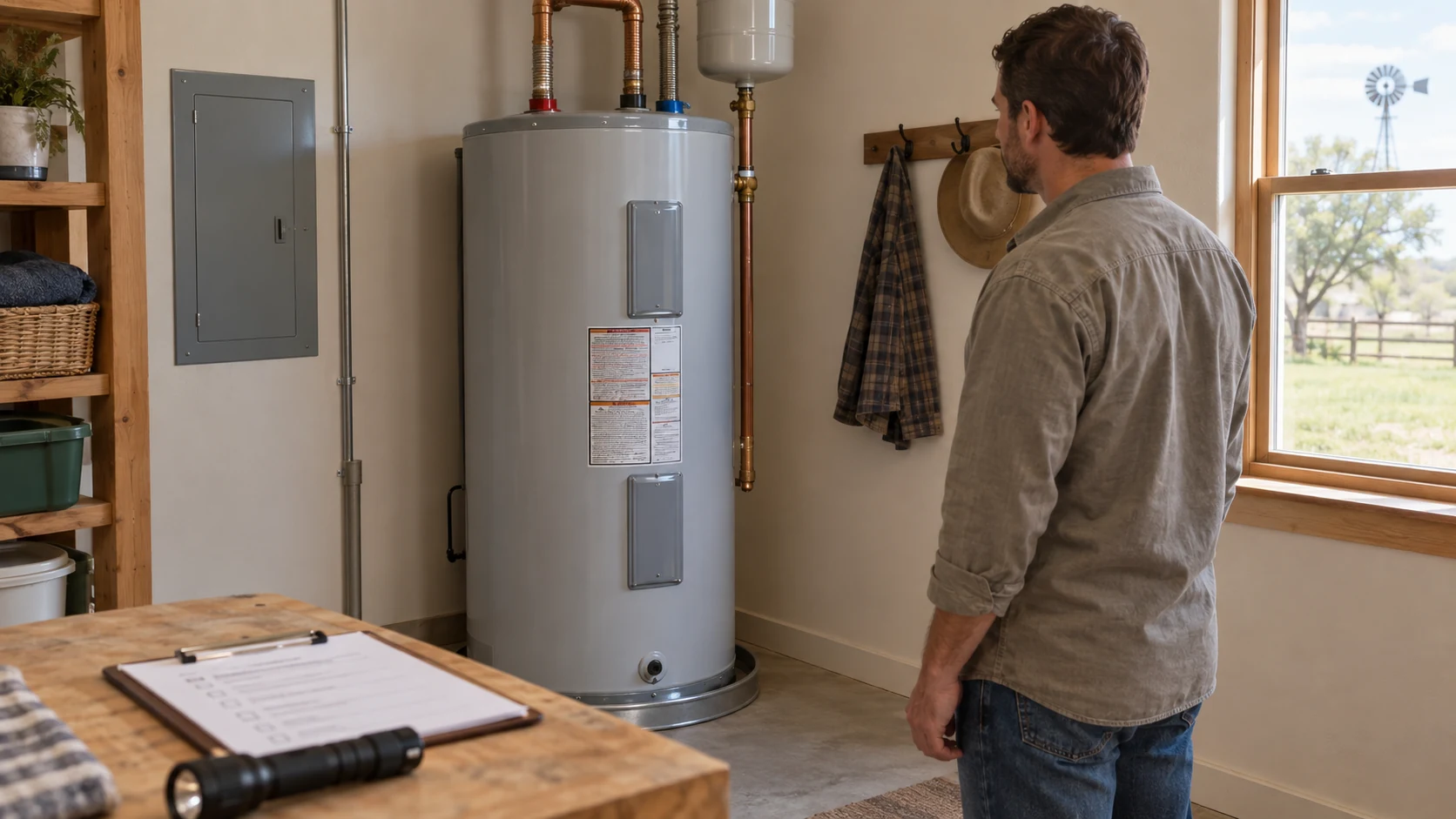
You can make the initial discussion more useful without taking equipment apart. Stay in a dry, accessible area and record only what you can see or hear without touching hot surfaces or removing covers.
- Performance: Whether the issue is no hot water, limited duration, slow recovery, or uneven temperature.
- Timing: Whether it occurs throughout the day or only during overlapping household use.
- Appearance: Visible moisture, staining, or corrosion around accessible connections and the floor.
- History: Previous repairs, treatment changes, and the date of the last documented service.
- Identification: Model and serial information visible on an accessible label.
Do not repeatedly reset a tripping breaker, relight an appliance that has been wet, or remove an electrical panel to investigate. An observation checklist should help explain the problem, not turn a maintenance article into a hazardous repair project.
The Anode Rod and the Limits of a Calendar Rule
Many conventional steel storage tanks use a sacrificial anode to help protect the tank from corrosion. Other designs use different arrangements, including powered protection. Do not assume every heater contains the same rod or that a replacement selected for another model is appropriate.
The heater's manual is the starting point for inspection intervals and replacement criteria. For example, an A. O. Smith residential electric heater manual calls for early inspection and later maintenance adjusted for water conditions. That example is not a universal schedule for every heater installed in Millsap.
Anode inspection involves the tank and its connections, so this guide leaves removal and replacement to a qualified technician. The technician must consider the model, access, pressure, temperature, and the condition of existing fittings. A stuck connection or deteriorated tank changes what work is sensible.
If an odor is part of the complaint, do not remove the anode permanently as a shortcut. The cause needs evaluation, and any change in anode type should follow the equipment manufacturer's guidance. Treating an odor without considering corrosion protection can exchange one problem for another.
Iron Horse's water heater service includes anode rods, heating elements, thermostats, pressure relief valves, and sediment-related problems. Ask for the recommended work and the reason for it, rather than requesting a particular part solely because an online description sounds familiar.
Flushing and Descaling: Similar Goals, Different Work
A tank flush is intended to remove removable sediment through a controlled service process. It does not repair a perforated tank, restore a failed electrical component, or guarantee removal of hardened deposits. An older heater with an unknown history needs an assessment before someone opens its drain valve.
There is no responsible one-size-fits-all instruction to flush every Millsap well-water heater twice a year. The correct interval should follow the actual model's manual, observed buildup, water quality, and usage. A written record of what was found during service is more helpful than a repeating reminder with no connection to those conditions.
Ask what the technician found and what that means for the next visit. Useful notes include the condition of the drain valve, whether sediment could be removed, whether further inspection was appropriate, and the recommended interval. “Flushed” alone does not describe the overall condition of a heater.
Tankless equipment has a different maintenance process. Descaling, inlet-filter service, and other checks must follow the specific manufacturer's instructions. Do not circulate an improvised chemical through a heater or assume a tank-maintenance procedure applies to a tankless unit.
Hot discharge water, electrical energy, gas equipment, and pressure make these tasks different from cleaning a faucet aerator. Keep them on the technician's side of this checklist. If you have already opened a valve and it will not close, stop and report that problem rather than forcing it.
Relief-Valve Discharge, Leaks, and Immediate Safety
A temperature and pressure relief valve is a safety device, not an overflow connection to silence. Never cap, plug, obstruct, or place a shutoff in its discharge path. A discharge complaint needs evaluation of the valve and the conditions causing it, not an improvised way to stop the water.
For this homeowner checklist, look without operating the valve. Report visible dripping, damaged discharge piping, or water in an unexpected place. Testing and servicing should follow the heater's instructions and be handled by someone prepared for hot water, discharge, and a valve that may not reseat.
Water near a tank can come from different places, including a connection, drain, relief line, or the tank itself. Do not assume the most expensive diagnosis, but do not dismiss an active leak as harmless condensation either. A technician needs to identify the source before deciding whether repair is appropriate.
Keep away from water near wiring, an electrical panel, or appliance controls. Close an accessible homeowner-operated water valve only if you can reach it safely and know what it controls. Do not enter standing water to reach switches, and do not operate water-damaged equipment.
Gas odor requires a different response. Leave the area immediately, avoid operating switches or appliances, and call emergency services and your gas provider from a safe location, consistent with Atmos Energy's gas-leak guidance. Do not assume an odor near a heater is simply a water-quality issue.
If moisture extends beyond the heater area or its source is unclear, Iron Horse's leak detection service may be relevant. Describe where you first noticed water and how it has changed without removing walls or entering an unsafe space.
Repair or Replace a Water Heater in Millsap?
The repair decision starts with the failure, not the age alone. A serviceable heater with a clearly identified component problem is different from a leaking tank or equipment that no longer suits the household. Ask what the proposed work will solve and what it will leave unresolved.
| Finding | Useful next question | What it does not establish |
|---|---|---|
| Reduced hot-water duration | Has demand changed, or is a component failing? | That sediment is the only cause |
| Visible moisture | Exactly which connection or part is leaking? | That the tank shell has failed |
| Repeat service visits | Are these related failures or separate issues? | An automatic replacement threshold |
| Significant tank deterioration | Can the tank safely remain in service? | That replacing one control will restore it |
| Household demand exceeds output | What capacity and recovery are needed? | That matching the old size is sufficient |
A confirmed leak through a storage tank's shell generally points to replacement rather than a patch. A fitting or valve problem may have a different answer. Have the source identified and documented so the recommendation follows the diagnosis.
When comparing options, include the installation as well as the equipment. Ask about available space, access for future maintenance, appropriate connections, and requirements specific to the selected unit. A replacement decision should address the household's actual use, not simply repeat the previous installation.
For tankless options, discuss incoming-water conditions, simultaneous fixture demand, and the maintenance expected by that model. Tankless is not automatically the right answer for a property with a private well. The equipment and water conditions have to work together.
Before scheduling replacement, ask the office about appointment availability, equipment options, and the work your installation may require. Explain any access restrictions or changes in household demand. Confirming those details helps you understand the proposed scope and prepare for the visit.
Water Treatment Without Guessing at the Problem
A softener, sediment filter, and other treatment equipment serve different purposes. Before choosing equipment, identify the condition being addressed and confirm that the proposed system is suitable for the water and household. “Well water” is not a complete treatment specification.
Iron Horse lists water softener installation among its residential plumbing services. Bring test results and existing equipment information to the discussion, and ask what the proposed treatment will and will not address. Avoid buying a system solely because another homeowner reports good results.
Treatment does not eliminate the heater's maintenance requirements. Some manufacturers call for closer anode attention under particular softened-water conditions. Review the heater and treatment instructions together rather than assuming that adding equipment means future inspections are unnecessary.
Keep the records in one place. Include the test report, treatment model, installation date, service findings, and any changes in hot-water performance. A documented pattern gives the next technician more to work with than an estimate of when the water first seemed different.
A September Checklist for Millsap Homeowners
Use September to organize information and arrange the work your system actually needs. Separate tasks you can do safely from inspections that require equipment, access, or technical judgment.
- Find the heater model and its manual without removing covers.
- Note the last documented maintenance and any repeat symptoms.
- Gather available well-water tests and treatment-system records.
- Look for visible moisture from a safe, dry position.
- Keep stored items clear of equipment and required access areas.
- Ask a qualified technician about flushing, anode inspection, and safety checks appropriate to the model.
- Request a written next-service recommendation based on the findings.
- Discuss repair versus replacement only after the cause is identified.
For a rural property, tell the office whether the heater serves the main home, guest quarters, or an outbuilding. Mention limited access, multiple heaters, and any equipment that has been unused for a long period. These details help define the visit; they do not require you to dismantle anything before it.
Consider how you will recognize a change after service. Keep a short note about which fixtures were affected, the household's usual hot-water demand, and whether the problem resolved. If the same symptom returns, share that history instead of assuming it must be the same failed part.
Arrange Water Heater Service in Millsap
Iron Horse serves Millsap through its Weatherford office, and the Millsap service-area page specifically addresses plumbing on well-fed properties. Call (817) 599-8765 to discuss water-heater symptoms, maintenance history, and the work you need assessed.
Scheduled service is Monday through Saturday, 7:00 AM to 6:00 PM, with 24/7 emergency plumbing service. The Weatherford office is at 2319 Tin Top Rd. When arranging a visit, confirm availability rather than assuming a particular arrival time or a complete replacement on the first call.
Read our customer reviews to hear about other customers' experiences, or visit the frequently asked questions for answers about plumbing services. For an active leak or loss of hot water, call (817) 599-8765 and explain what is happening so the office can assess the request.
Frequently Asked Questions About Millsap Water Heaters
How often should a well-water heater in Millsap be flushed?
Use the manufacturer's instructions and actual service findings, not a fixed rule for every well. Water chemistry, sediment, equipment type, and usage affect the recommendation. Ask the technician to document what was found and when the next inspection should occur. This guide does not recommend opening a tank drain as a casual homeowner test.
Does a popping water heater always need replacement?
Popping or rumbling can be associated with deposits, but the sound alone does not establish the cause or the right repair. Tell the technician when it occurs and whether hot-water performance has changed. Tank condition, components, and maintenance history matter. Do not remove access covers or repeatedly reset equipment to investigate the noise.
Does every private well shorten a water heater's life?
Private wells have different water chemistry, and municipal water is not automatically soft. The useful question is how your measured water conditions interact with your particular heater and maintenance history. A water test and equipment inspection are more informative than a general prediction. No article can establish the remaining life of an individual tank.
Can water near the bottom of a heater be repaired?
The answer depends on the source. A leaking connection or serviceable valve is different from a leak through the tank shell. Keep clear of water near electricity and report the location without dismantling equipment. A qualified technician should identify the source before recommending repair or replacement, especially if water is continuing to spread.
Should a Millsap homeowner remove an anode to stop an odor?
Do not permanently remove corrosion protection as an odor remedy. The source of the odor and the manufacturer's approved options need evaluation. If you suspect a gas leak, leave immediately instead of troubleshooting the heater. A hot-water odor that is not a gas emergency still deserves a diagnosis rather than an unverified part change.
Will installing a softener eliminate heater maintenance?
A softener does not replace the heater's inspection and service requirements. Treatment should be selected for test results and the equipment involved, and anode maintenance may need attention under softened-water conditions. Keep both manuals and ask how the systems should be maintained together. Reducing one water-quality issue does not resolve every possible heater problem.
Topics