Water heater replacement in Weatherford starts with a diagnosis, not an assumption that cold showers mean the tank is finished. Colder incoming water can increase the work needed to reach the desired temperature, making slow recovery or limited capacity more noticeable during winter. A failed component, a change in household demand, or a leak can also explain the problem. Those possibilities call for different responses.
Weatherford includes older homes near its historic downtown and newer construction across Parker County. The right replacement must suit the actual property: available space, fuel or electrical supply, venting, and the household's busiest hot-water period. This guide explains what symptoms can tell you, how repair and replacement decisions differ, and what a professional installation should address. It also separates a loss of hot water from hazards that require immediate evacuation or emergency help.
What "No Hot Water" Actually Means
No hot water is a symptom, not a diagnosis. Start by noting whether every fixture is affected, whether the change was sudden, and whether the heater produces any hot water before it runs cool. These observations help a technician investigate without asking you to open equipment or handle wiring.
- A sudden total loss of hot water can involve power, controls, heating elements, ignition, or fuel supply, depending on the appliance.
- Hot water that runs out sooner can reflect higher demand, a failed heating component, sediment, or a mixing problem. It does not automatically mean the tank is undersized.
- Lukewarm water can involve controls, a dip tube, or cold water mixing into the hot-water system.
- Slow recovery can reflect equipment capacity, a malfunction, or a greater temperature rise when the incoming water is colder.
Popping, rumbling, discolored water, and unusual odors are clues rather than proof of a single failure. Water around the base may come from a connection, a valve, condensation, or the tank itself. A technician should locate the source before recommending replacement; a confirmed leak through the tank shell is different from a repairable connection leak.
Do not assume a rotten-egg smell is harmless water chemistry when a gas appliance is nearby. If you suspect a gas leak, leave immediately and follow the emergency guidance below. Do not remove electrical access panels, reset a repeatedly tripping breaker, adjust gas controls, or bypass a safety device to keep the heater running.
Our water heater service covers tank and tankless diagnosis, component repair, sediment-related service, replacement, and properly sized installation. We service all major brands, so the recommendation should follow the condition of the equipment and the needs of the home.
Water Heater Repair or Replacement in Weatherford
A repair can be sensible when the problem is a replaceable component and the rest of the system is sound. Replacement becomes more appropriate when the tank itself has failed, the equipment cannot safely serve the home, or repeated failures make another repair difficult to justify. Age matters, but it is not a diagnosis by itself.
Repair is worth discussing when:
- The tank is sound and testing identifies a serviceable component.
- The equipment can be operated safely after the repair.
- Compatible parts are available.
- Capacity was adequate before the current problem appeared.
- The surrounding connections, venting, and installation can meet applicable requirements.
Replacement deserves a closer look when:
- A professional confirms leakage through the tank shell.
- Significant deterioration affects safe operation or repairability.
- Several failures have occurred and the remaining condition is poor.
- Correctly functioning equipment still cannot meet the household's demand.
- The installation cannot be made suitable for the proposed use without substantial changes.
Rust-colored hot water alone does not establish that the tank lining has failed, and well water alone does not establish that replacement is necessary. A flush or anode-rod service is not a universal cure either. Ask what was inspected, what failed, and which observations support the proposed work.
There is a middle case worth discussing: a repair may restore normal operation, yet the household now uses more hot water than the original system can provide. An added bathroom or a different shower schedule can change the decision. Iron Horse offers free estimates on most non-emergency plumbing projects, allowing planned replacement options to be discussed before work begins.
Sizing a Tank for How Your Household Actually Uses Hot Water
Sizing should reflect actual hot-water use rather than simply copying the old tank's gallon capacity. Bedroom count alone cannot describe how a household showers, does laundry, and uses other fixtures. Two households in similar homes can need different performance.
Two numbers matter. The first is peak-hour demand: the most hot water the house will draw in the busiest sixty minutes of the day. That is usually a weekday morning. Count what really overlaps - two showers back to back, a load of laundry, a dishwasher started before everyone leaves. The second is first-hour rating, which is how much hot water a tank can deliver in one hour starting fully heated. First-hour rating combines stored volume with recovery, which is why two tanks of the same nominal size can behave differently.
The Department of Energy's remodeling guide explains the relationship between peak-hour demand and first-hour rating. Compare that rating with the busiest hour, rather than treating tank volume as the only measure.
Questions to discuss during sizing include:
- How many people, and how much of the demand collides in one window
- Number of bathrooms, and whether any has a large tub or a multi-head shower
- Whether laundry and dishwashing typically run during the peak window
- Whether the house has long runs to a far bathroom, which wastes hot water on every draw
- Whether the heater feeds any fixture the household would rather not compromise, like a bathtub used for small children
- On rural Parker County properties, whether the supply is a private well, which affects both water chemistry and inlet temperature
For example, a home that once housed two people may now have five occupants using showers in quick succession. That is a hypothetical demand change, not evidence of a defective tank. Upsizing, a different recovery rate, or another configuration may help, but the available space and utility capacity still need review.
Tank or Tankless
Iron Horse installs both tank and tankless systems. The choice should follow demand, available utilities, maintenance needs, and the property rather than a blanket claim that one technology is always better.
A storage tank can suit a household that wants a replacement compatible with the existing location and services. Stored hot water helps meet short periods of overlapping demand. Tank volume, recovery, and first-hour rating must still be considered together; choosing a larger tank without checking performance can miss the actual problem.
Tankless systems heat water as it passes through the appliance instead of drawing from a stored supply. That can suit long or repeated hot-water use, but output is not unlimited. The appliance must deliver the required flow at the needed temperature rise. Several simultaneous fixtures can exceed its capacity, and colder incoming water can reduce available hot-water flow.
The Department of Energy's tankless retrofit guide emphasizes sizing for simultaneous demand and the required temperature rise. It also calls for reviewing gas or electrical capacity, venting, combustion air, and condensate arrangements where applicable. A conversion is not automatically a like-for-like swap.
In an older Weatherford home, access and an existing vent route may influence the options. In any home, a gas tankless unit may require supply changes, while a whole-house electric model can place substantial demands on the electrical service. Those questions belong in the assessment before equipment is selected.
Water quality and manufacturer-recommended maintenance also matter. Scale can affect heat-transfer surfaces, but a private well does not automatically mean the water is hard. Discuss actual water conditions, testing where appropriate, and the appliance's maintenance requirements rather than assuming every Parker County property needs the same treatment.
What a Water Heater Replacement in Weatherford Should Address
A water heater replacement should address the equipment and the conditions around it. Iron Horse's stated replacement service includes proper sizing, code-compliant connections, and disposal of the old unit. The company identifies Texas Master Plumber License M-37011 on its website.
The exact requirements depend on the appliance, installation location, manufacturer instructions, and applicable local rules. Ask the installer to explain relevant items such as:
- Space, access, service clearances, and a safe removal route.
- Compatible water connections and protection against corrosion where needed.
- A suitable temperature-and-pressure relief valve and correctly routed discharge piping.
- Thermal-expansion control where the plumbing system requires it.
- Fuel connections, combustion air, and venting for a fuel-fired unit.
- Electrical supply and disconnecting arrangements appropriate to the appliance.
- An accessible, functional water shutoff.
- A drain pan and drainage provisions where required.
- Support, elevation, or protection required for the installation location.
- Applicable permit and inspection requirements.
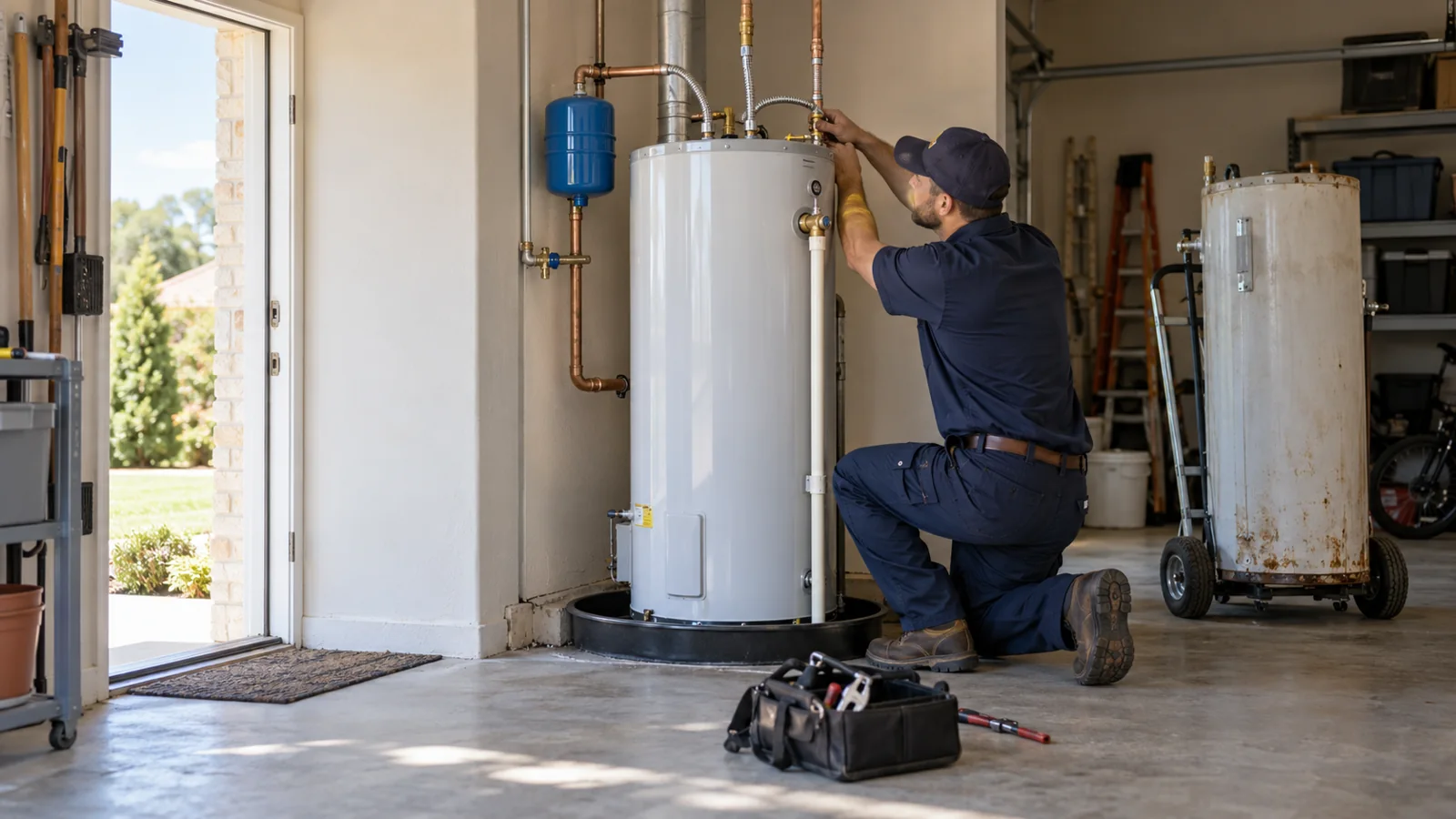
- Filling, startup, leak checks, and verification of operation before handoff.
This is an assessment checklist, not an installation procedure. Homeowners should not cap or plug a relief discharge, adjust a gas valve, rewire a heater, or remove a safety device. A relief valve releasing water needs diagnosis; blocking it does not solve the underlying condition.
Discuss temperature settings and scald protection during handoff, especially when children or people with reduced mobility use the home. Raising the temperature to compensate for insufficient capacity is not a substitute for diagnosis. Ask how the selected equipment should be maintained and what warning signs require a call.
Where the plumbing around the heater needs attention, our broader residential plumbing services can be discussed as part of the assessment. Confirm the scope before work begins rather than assuming every nearby issue is included in a replacement.
Century-Old Homes Near Downtown Weatherford Versus New Subdivisions
Weatherford's mix of older homes near downtown, newer subdivisions, and development along I-20 and US-180 creates different planning considerations. The age of a neighborhood does not diagnose its plumbing, but it is a useful reminder to inspect the actual installation instead of assuming a standard replacement will fit.
In an older property, check the available closet space, access openings, supply materials, and existing vent route. Previous remodeling may have changed the room around the heater. A new unit with a similar advertised capacity can have different dimensions or clearance requirements, so measure the route and location before selecting it.
Newer construction also needs an individual assessment. Household use can differ from the assumptions behind the original equipment selection. A working heater may be adequate for staggered showers but not for several fixtures operating together. That is a demand question, not proof that all newer homes contain inadequate equipment.
Location affects the consequences of a leak. An attic installation above finished rooms needs particular attention to required drainage provisions and access. A garage location has its own appliance-placement and protection considerations. Ask how leaks would become visible and which shutoff is intended for homeowner use.
Keep residential and commercial sizing separate. A household's morning shower demand is not equivalent to a restaurant or another business with repeated high-volume use. Describe the property and its use when arranging an assessment so the discussion starts with the correct type of system.
When a Failing Water Heater Is an Emergency
A loss of hot water and a dangerous appliance condition are not the same situation. Treat suspected gas leakage, a carbon monoxide alarm, smoke, fire, electrical burning, or scalding discharge as safety concerns first, rather than staying beside the heater to diagnose it.
If you smell gas or suspect a leak, leave immediately. From a safe distance, call 911 and your gas utility's emergency line, following the Atmos Energy gas-leak guidance. Do not remain inside to shut off equipment, use switches, or make a routine plumbing call. Do not re-enter until the responsible emergency personnel say it is safe.
For active water leakage without those hazards, keep people away from hot water and wet electrical equipment. Close a clearly identified homeowner-operated water shutoff only if it is safely accessible. Do not enter standing water, climb into an unsafe attic, handle gas controls, or touch wet wiring to reach the appliance. Let the responding professional guide the remaining shutdown.
Do not drain a hot tank into a bucket, open a relief valve to investigate, relight a suspect heater, or restore power to equipment that may be empty or damaged. Report where the water is coming from if you can observe it safely, and mention any noise, steam, burning smell, or alarm.
Our 24/7 emergency service includes water heater diagnosis, repair, and replacement, including weekends and holidays. For no-hot-water situations without immediate hazards, explain whether vulnerable occupants are affected so the team can assess urgency. Emergency service availability does not mean every replacement can be completed immediately.
Same-Day Replacement and What the Visit Looks Like
Iron Horse advertises same-day water heater replacement on its service page. Call to confirm what is possible for the specific job rather than assuming every appliance, access problem, or utility upgrade can be handled within that window.
A professional assessment should establish whether the heater itself has failed, whether a repair is appropriate, and what performance the household needs. The proposed equipment must fit the location and be compatible with the gas, electrical, water, and venting arrangements. If those conditions need changes, the scope and timing should be explained before removal begins.
After installation, ask for an explanation of normal operation, the shutoff location, maintenance recommendations, and the signs that warrant a call. Keep the model and serial information with the installation paperwork. This makes future service discussions more useful than relying on an approximate tank size or an uncertain installation year.
You can read customer feedback on our reviews page. Reviews provide context about customer experiences, but they are not a guarantee of timing or results for a different property.
Getting Water Heater Help in Weatherford
Our Weatherford office at 2319 Tin Top Rd serves Weatherford and the surrounding Parker County communities, and you can see the full scope of local work on our Weatherford service area page. Scheduled service is Monday through Saturday, 7am to 6pm, with 24/7 emergency service including weekends and holidays.
If your hot water is failing, running short, or the tank is showing rust at the base, call (817) 599-8765 and describe what you are seeing - the sounds, where the water is, how fast it runs out. Mention the fuel type and approximate age if you know them, without removing covers or moving the appliance. More answers to common questions are on our FAQ page, and for urgent plumbing help once everyone is safe, call (817) 599-8765 rather than waiting for regular hours.
Frequently Asked Questions
How long does a water heater last in Weatherford homes?
There is no single lifespan that applies to every home. Equipment type, water conditions, maintenance, use, and the condition of the installation all matter. A model's age helps frame the discussion, but it cannot establish that the tank has failed. Ask a technician to explain the observed condition and repair options rather than recommending replacement from the calendar alone.
Should a Weatherford homeowner repair or replace a water heater?
Repair may make sense when testing identifies a serviceable component and the tank and installation remain sound. A confirmed tank-shell leak, serious deterioration, repeated failures, or inadequate performance can support replacement. Rusty water or a puddle alone is not a complete diagnosis. The source and cause should be identified before deciding which work is necessary.
What size water heater does a house need?
Sizing follows the household's busiest hot-water period rather than tank gallons alone. For storage heaters, compare peak-hour demand with first-hour rating. Consider overlapping showers, appliances, tubs, and changes in occupancy. Then check dimensions, service clearances, fuel or electrical capacity, and installation requirements. A larger label does not automatically solve a slow-recovery problem or a failing component.
Is a tankless water heater a good choice in Weatherford?
Tankless can suit repeated hot-water use or some space-constrained installations, but it has a flow limit at a given temperature rise. Sizing must account for simultaneous demand and cold incoming water. The assessment should also review fuel or electrical capacity, venting where applicable, and maintenance needs. It is an option to evaluate, not an unlimited-output replacement for every tank.
Do you replace water heaters the same day?
Iron Horse advertises same-day water heater replacement, and the Weatherford office can assess availability for your job. Equipment suitability, access, and required installation work affect what can be completed. Emergency plumbing service is available around the clock, including weekends and holidays, but that is not a promise that every replacement will be finished immediately.
Why does hot water run out faster in winter?
Colder incoming water increases the temperature rise needed to produce hot water and can make limited recovery more noticeable. Demand changes, faulty components, or other system problems can also explain shorter showers. Do not assume sediment is always responsible or that February is every home's coldest-water month. Report the pattern so the cause can be checked.
Topics