A suspected slab leak in Aledo may first appear as an unexplained sound, a warm floor patch, or increased water use rather than visible flooding. By the time a homeowner calls us, the leak has usually been running for a while, quietly saturating the soil and fill under the foundation. April is a good month to pay attention here, because spring is when a lot of Parker County homeowners finally turn the irrigation back on, start using the hose bibs again, and mistake a real slab leak for seasonal water use. The difference between catching it early and catching it late is rarely about luck. It is about knowing which signs matter and getting a real diagnosis instead of a guess.
What a slab leak actually is
A slab leak is a failure in a pressurized water line or a drain line that runs beneath or through a concrete foundation. That distinction matters more than most people expect, because the two behave differently and get found differently.
A supply-side slab leak is under constant pressure. Whether anyone is home, whether the faucets are off, whether it is two in the morning, that line is pushing water out of the failure point every second. Supply leaks tend to get worse in a predictable curve: a pinhole becomes a wider pinhole, then a split, and the volume of water climbs the whole time. They are the leaks that show up on a water bill and the leaks that create hot spots when the failure is on the hot side.
A drain-side slab leak only leaks when something upstream is draining: a shower, a washing machine cycle, a sink full of dishwater. Being intermittent makes them harder to catch in the act and easier to dismiss, and they rarely raise a water bill, because the water was already metered. Instead they soak the subgrade with wastewater, produce smells that come and go, and undermine the fill under the slab.
Both types of failures happen for boring reasons. Copper supply lines under a slab develop pinholes from the outside in, especially where the pipe passes through concrete without proper sleeving and gets abraded by movement. Older galvanized runs corrode from the inside. Fittings stressed during the original build can weep for years before they let go. Drain lines crack when soil moves, when the original bedding settles unevenly, or when a joint was never fully seated. North Texas soil swells when wet and shrinks when dry, and every cycle stresses whatever is buried in it.
Why Aledo homes see slab leaks across two very different housing types
Aledo is not one housing stock, and that changes how we approach a leak call. The city page for Aledo describes exactly the mix we see in the field: established neighborhoods alongside newer subdivisions, plus larger-acreage properties spread out between them.
In established Aledo neighborhoods, the plumbing has had decades to age. Original fixtures are still in service, valves are stiff or weeping, and supply lines have been through many wet-dry soil cycles. When we find a slab leak in one of these homes, it is often not the first weak point in the system, just the first one to fail loudly. That is important context for the repair-versus-replace conversation later on.
In newer Aledo subdivisions, the pipe is usually in good condition, but the systems are high-demand. Multiple full baths, large soaking tubs, high-volume showers, and a heavy irrigation schedule mean more pressure cycling and more total flow through the same runs. Newer does not mean immune. A fitting crimped a hair off during a fast build-out will still fail, and it fails under a slab that is often larger and more finished than those in older homes.
The larger-acreage properties are their own category. Longer supply runs between the meter, the house, outbuildings, barns, and irrigation zones mean there is simply more buried pipe to fail, and more of it sits outside the slab entirely. On those properties we cannot assume a pressure loss is a slab leak until we have ruled out the yard line, and we say so before anyone gets near the concrete.
The warning signs Aledo homeowners miss
The homeowners who catch slab leaks early are almost never the ones who saw water. They are the ones who noticed something small and did not explain it away.
- A warm or hot patch on the floor. A hot-side leak can cause this, but warmth alone is not a diagnosis. If one section of tile or wood is noticeably warmer than the floor a few feet away and there is no duct or sunlight to explain it, you likely have hot water running under the slab.
- A water bill that steps up and stays up. Not a spike, a step. A leak does not take holidays, so the usage graph tends to move to a new, higher plateau rather than jumping and coming back down.
- The sound of running water with everything off. In a quiet house at night, a faint continuous hiss behind a wall or under the floor is a pressurized leak being audible.
- A water heater that runs more than it used to. A hot-side slab leak makes the heater reheat water that is going into the ground. Recovery feels slower and the burner or elements cycle more often.
- Low water pressure that came on gradually. A supply leak bleeds off pressure continuously. If showers went from strong to adequate to weak over a few months, that is worth a diagnosis.
- Floor damage with no obvious source. Tile that has started to crack in a line, wood that has cupped in one area, carpet that feels cool and slightly damp in a specific spot.
- Smells that come and go. Drain-side leaks produce odor when the affected fixture is in use, then fade. A musty smell in one room is a pattern, not a coincidence.
- Foundation movement that speeds up. Persistent water changes the moisture content of the soil under one section of the slab. Doors that suddenly stop latching, or new cracks appearing over a short span of time, deserve a plumbing check alongside any structural opinion.
None of those signs alone proves a slab leak. Several unexplained signs justify an inspection rather than guessing. Our leak detection service exists for exactly that moment, when the symptoms are real but the location is unknown.
How we find a slab leak without breaking concrete first
The single worst approach to a slab leak is opening the floor where the symptom appeared. Water travels along the path of least resistance under a slab, and the wet spot you can feel is frequently several feet from the actual failure. Non-invasive location comes first, always.
Isolation and pressure testing
We start by isolating the system. That means shutting off supply at the right point, closing off fixtures and branches in sequence, and watching whether the system holds pressure. A pressure test tells us three things quickly: whether there is a leak at all, whether it is on the hot side or the cold side, and roughly how large it is. A system that bleeds off slowly is telling a different story from one that drops immediately.
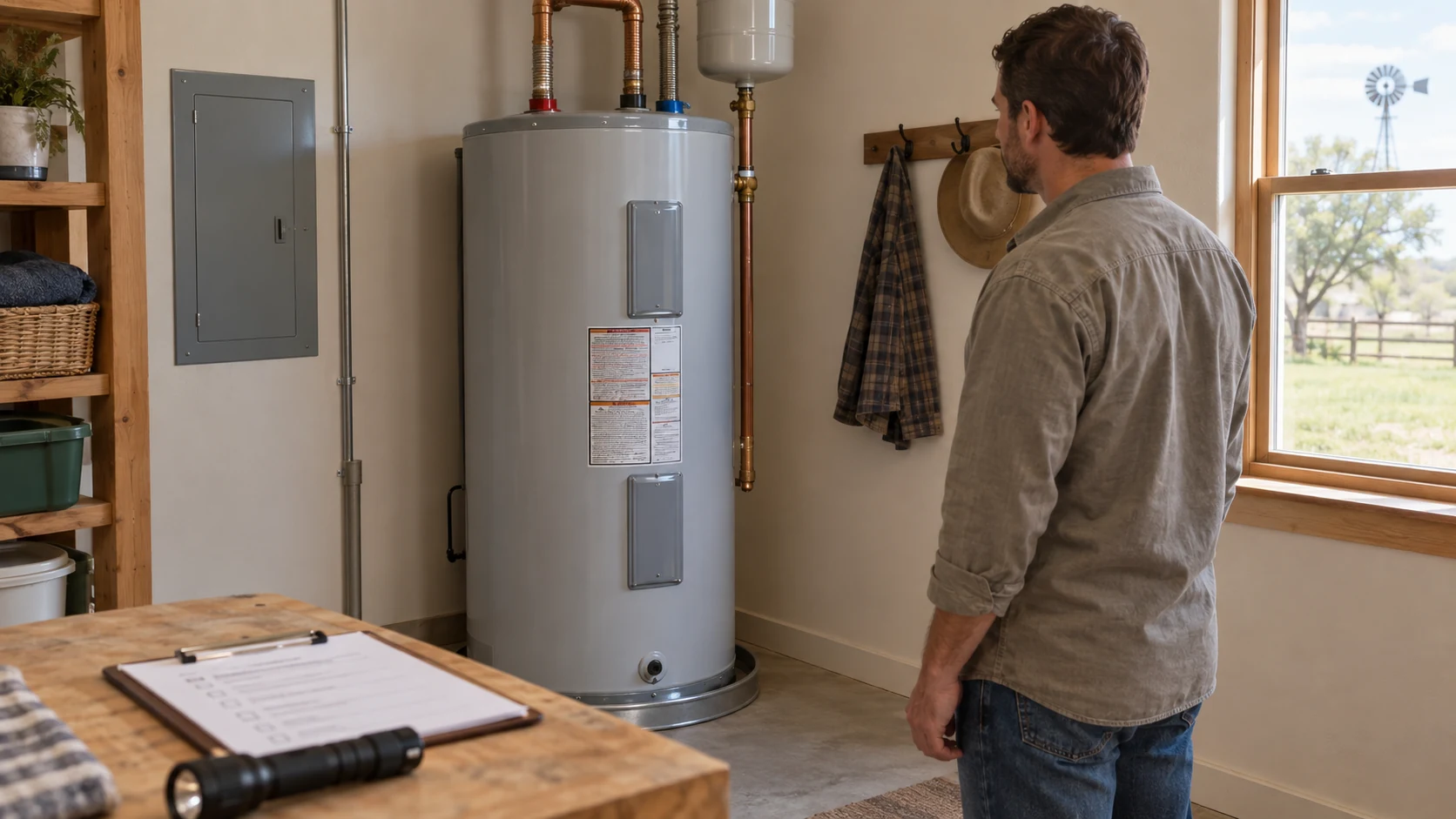
Isolating the water heater is a routine early step, because separating the hot and cold sides cuts the search area in half in a matter of minutes. If pressure holds on the cold side and falls on the hot side, we now know we are looking for a hot line, and the hot spot you felt on the floor suddenly means something concrete.
Acoustic detection
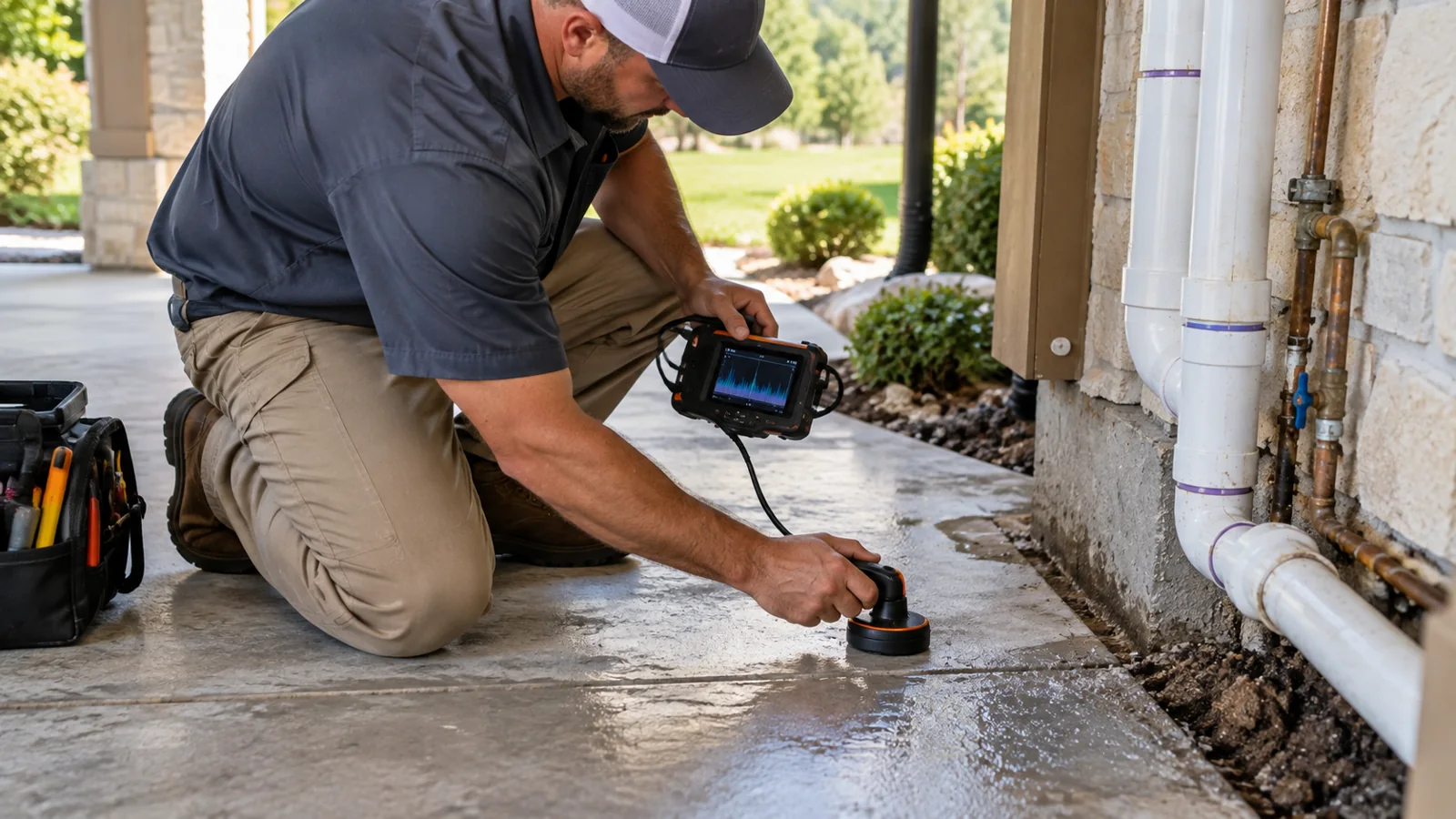
Pressurized water escaping from a pipe makes noise. It is not loud, and through several inches of concrete and a floor covering it is inaudible to an ear, but acoustic detection equipment picks up the specific frequency signature of water exiting a pipe under pressure. We work a grid across the suspect area, listening for the point where the signal is strongest, then tighten the grid around that point.
Acoustic work is as much about eliminating noise as finding it. Refrigerators, HVAC equipment, a cycling well pump, and traffic all interfere, which is why we ask for a quiet house during the listening phase.
Reading the whole picture before marking a spot
Before we mark a location, we cross-check. The acoustic peak should agree with the pressure test result, with the plumbing layout, and with the physical symptoms. If the acoustic signal says one corner and the hot spot is fifteen feet away with no plausible path between them, we keep working rather than commit. Marking the wrong spot means opening the wrong floor, and that is a mistake a homeowner pays for in finished flooring, not in pipe.
Drain-side suspicions follow a different sequence, because an unpressurized line makes no leak sound. There we look at the drainage system itself and at where water shows up relative to the fixtures feeding it.
Repair or replace: the honest reasoning
Once we know where the leak is, the real conversation starts, and it is not always about the leak.
A spot repair makes sense when the pipe around the failure is in good condition, the failure has a clear mechanical cause, and access is reasonable. A copper line in a newer Aledo subdivision that developed a pinhole at an abrasion point is a good spot-repair candidate. Open the floor at one location, cut out the damaged section, make a proper repair, close it back up.
A spot repair stops making sense when the failure is a symptom of the whole run being at the end of its life. If we open the concrete and find pipe that is thin, pitted along its length, or already weeping at a second point, patching one hole just moves the next call a few months down the calendar. In an established Aledo neighborhood with original supply lines, this is a real possibility and we will tell you when we see it.
That is when a re-pipe enters the discussion. Rerouting supply lines is often the better answer than repeatedly chasing failures under a slab, because the new runs are accessible for the rest of the home's life. It is a larger job and a bigger decision, and it belongs to the homeowner, not to us. Our part of it is straightforward: show you what the pipe looks like, explain what we expect from it, and lay out both paths honestly. Full re-pipe work sits inside our residential plumbing services alongside the smaller copper repairs, so the same crew can handle either outcome.
Two things we will not do. We will not recommend a re-pipe because a single fitting failed on otherwise sound pipe. And we will not patch a line we believe is finished just because patching sounds easier in the moment.
When a slab leak becomes an emergency
Most slab leaks are urgent rather than emergencies. They need a diagnosis soon, not at midnight. Some situations flip that.
- Water actively coming up through the floor or pooling inside the home
- A sudden, dramatic pressure loss, which often means a line has gone from pinhole to split
- Water near an electrical panel, outlet, or any powered equipment
- Sewage smell with visible moisture, which suggests a drain-side failure with contaminated water
- A leak you cannot stop because you cannot find or turn the main shutoff
If you are in any of those situations, shut the water off only if the valve is safely accessible, stay out of standing water near electrical equipment, and call. Knowing where your main shutoff is, and confirming the valve actually turns before you need it, is one of the highest-value ten-minute tasks any homeowner can do. Our 24/7 emergency plumbing covers exactly these calls, including weekends and holidays. Scheduled service runs Monday through Saturday, 7am to 6pm, and for anything outside that window the emergency line is the right call. For the fastest response, call the office directly at (817) 599-8765.
What waiting on a slab leak actually costs
There is a real cost to waiting that has nothing to do with the plumbing work itself.
Continuous water under a slab changes the soil. Expansive clay swells where it is wet and stays shrunken where it is dry, and a slab bridging both conditions is asked to flex in a way it was not designed to. Persistent moisture also migrates into flooring, baseplates, and insulation, which is where mold conversations begin. A leak found in week two is a plumbing repair. The same leak in month eight can become a flooring project and a foundation opinion.
There is a diagnostic cost too: early leaks give clean signals, while months of saturation muddy the acoustic picture.
Aledo and the surrounding Parker County properties we cover
Our Weatherford office at 2319 Tin Top Rd handles Aledo along with the rest of Parker County, which keeps our crews close to these neighborhoods rather than routing them across the region. Just west of Aledo, Annetta presents a related but distinct version of the same problem: larger lots, low-density development, larger homes, and longer supply runs, often paired with septic systems. On those properties the buried pipe between meter, house, and outbuildings is frequently the actual culprit, and slab work is what we rule out rather than what we find.
Iron Horse Mechanical & Plumbing Services has been serving this area since 2014, and we are a locally owned, licensed and insured Texas plumbing contractor operating under Texas Master Plumber License M-37011. Co-founders Harold "Junior" Ferguson, a Master Plumber out of Lipan, and Shawn Chaviers of Stephenville built the company around this region specifically. You can read more about our team and how we work.
We also offer free estimates on most non-emergency plumbing projects.
What to do this week if you suspect a slab leak
A short, practical sequence any Aledo homeowner can run before calling:
- Turn off every fixture and appliance that uses water, including the ice maker and irrigation controller.
- Find your water meter and watch the leak indicator or the dial. If it is moving with everything off, water is going somewhere.
- Close the shutoff valve on the house side, if you have one, and check the meter again. Still moving means the leak is between the meter and the house. Stopped means the leak is inside or under the home.
- From a dry, safe area, note unusual floor warmth. Do not walk barefoot through moisture or damaged flooring.
- Stand still in a quiet house and listen near interior walls and floors.
- Pull up two or three months of water usage and look for a step change.
Bring us those six answers and the diagnosis starts much further along. Call the Weatherford office at (817) 599-8765 to get a slab leak in Aledo looked at properly, and we will locate it before anyone talks about opening concrete.
Frequently asked questions about slab leaks in Aledo
How do I know if I have a slab leak or just a dripping fixture?
Shut off every fixture in the house and watch the water meter. A dripping faucet stops registering when you close its valve; a slab leak keeps the meter moving with everything off. Add the other markers: a warm floor patch, a gradual pressure decline, and a water bill that stepped up and stayed up all point past fixtures to a line under the slab.
Does finding a slab leak mean tearing up my floor?
No. Location comes before any demolition. We isolate the system, pressure test to determine whether the leak is on the hot or cold side, then use acoustic detection equipment to pinpoint it through the slab. Non-invasive location is the entire point, because opening concrete at the wrong spot costs you finished flooring and tells us nothing about where the pipe actually failed.
Why do newer Aledo subdivisions get slab leaks too?
Newer pipe is not immune pipe. Aledo's newer subdivisions run modern high-demand systems, with multiple baths, high-volume fixtures, and heavy irrigation cycling pressure through the same runs. A fitting seated slightly off during a fast build-out will eventually weep, and an unsleeved line passing through concrete can abrade against it regardless of the home's age.
Should I repair the leak or re-pipe the house?
It depends on the condition of the pipe we find, not on the leak itself. If the surrounding line is sound and the failure has a clear mechanical cause, a spot repair is the right call. If the pipe is thin, pitted along its length, or already weeping elsewhere, patching one point just schedules the next failure. We show you the pipe and explain what we expect from it before you decide.
Is a slab leak an emergency in Parker County?
Usually it is urgent rather than an emergency. It becomes an emergency when water is coming up through the floor, pressure drops suddenly, water reaches electrical equipment, there is a sewage smell with visible moisture, or you cannot shut the water off. Our emergency service runs 24/7 including weekends and holidays; scheduled service is Monday through Saturday, 7am to 6pm.
Can a slab leak damage my foundation?
Continuous water under a slab changes the moisture content of the soil beneath one section of it, and North Texas clay swells when wet and shrinks when dry. A slab bridging wet and dry soil is being asked to flex in ways it was not designed for. That is why new cracks or doors that suddenly stop latching are worth a plumbing check alongside any structural opinion.
Topics