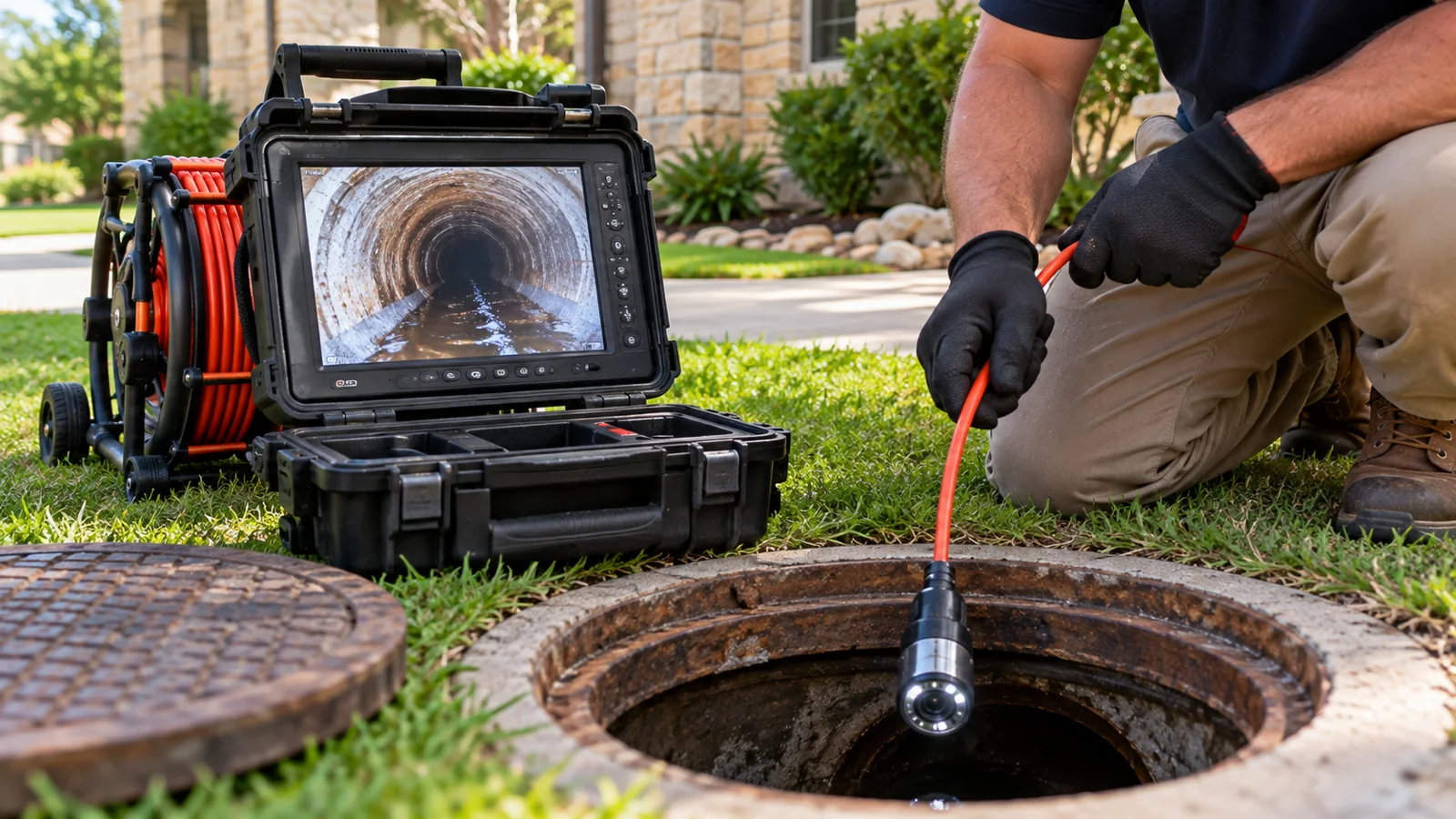
A sewer line in a Dublin home is easy to overlook because most of it is out of sight. Homeowners in Dublin know the age of their roof and the age of their water heater, and almost none of them know what the inside of their main line looks like, which is unfortunate, because that is where the most disruptive plumbing failures come from. The good news is that it stopped being a mystery a long time ago. An HD camera can show visible pipe defects and blockages; footage, measurements, and other tests help determine why a drain keeps backing up. June is a sensible month to do it here, because early summer is when tree roots are working hardest to find water and when a line that limped through spring finally gives up.
What a camera inspection actually shows
People picture a camera inspection as a yes-or-no test for a clog. It is considerably more than that. A proper run down a main line answers a list of questions that no other method can answer without digging.
- Where the problem is, measured in feet from the access point. Not "somewhere in the back yard," an actual distance we can mark on the ground.
- What the problem is. Roots, grease, scale, a collapsed section, a foreign object, or a joint that has separated.
- What the pipe is made of. Cast iron, clay, galvanized, Orangeburg, PVC, and each one fails in its own way and on its own timeline.
- The condition of the pipe wall. Scaled and rough, pitted, cracked, or sound.
- Whether the line has belly or sag. A low spot holds water and solids permanently, and it will clog again no matter how many times it is snaked.
- Where the joints are and whether they have shifted. Joints are where roots get in, almost without exception.
- Whether there is a usable cleanout, and whether it is in the right place.
That list is the difference between a repair plan and a guessing game. Snaking a line that has a bellied section will clear today's blockage and teach you nothing about why it is the third blockage this year. Our sewer line services start with the camera for precisely that reason, because the decision that follows, whether to clean, treat, line, or replace, depends entirely on what the pipe looks like inside.
Why Dublin lines fail in two distinct patterns
Dublin is a useful example of how one town can produce two completely different sewer diagnoses depending on which street you are on. The city page for Dublin names the split directly: older galvanized and cast-iron systems around the downtown area, newer PEX on the outskirts, plus well-water hardness outside the city limits.
Older lines near downtown
Around the older part of town, the drainage systems have decades on them. Cast iron corrodes from the inside out, and as it does the interior wall roughens and scales, which narrows the effective diameter and gives waste something to catch on. Older systems also frequently include clay sections downstream, and clay pipe is jointed every few feet with joints that separate as soil moves. Every one of those joints is a potential entry point for roots.
Mature trees are part of what makes those older streets pleasant, and they are also the reason those lines have root problems. A tree that has been in place for forty years has a root system that has thoroughly explored everything within reach, including a sewer line that is leaking a small amount of warm, nutrient-rich water at a joint.
Newer construction on the outskirts
On the outskirts, newer PEX supply and modern drainage change the picture. The pipe is smoother, the joints are solvent-welded or gasketed rather than mortared, and root intrusion is far less common. What we find out there instead tends to be installation-related or soil-related: a section with insufficient slope, a belly that developed as the backfill settled, a joint that was not fully seated, or damage from later landscaping and trenching work.
The well-water hardness outside the city limits adds one more factor. Hard water and soap leave a residue that coats the inside of drain lines, and that coating is what grease and hair grab onto. It is not the cause of a main line failure, but it is why the same branch drain slows down repeatedly on rural properties even when the main is fine.
How tree roots get into a sewer line
Roots do not drill through sound pipe. They find water, and they exploit an opening that already exists.
A sewer line carries warm water, nutrients, and moisture, which is an excellent target in a dry Texas summer. If a joint has separated slightly, or a hairline crack has opened, vapor escapes into the surrounding soil. Roots grow toward that vapor. A root that reaches the opening starts as a hair-thin feeder root that slips through a gap far too small to matter structurally.
Then it thrives. Inside the pipe, that root has unlimited water and nutrients, so it grows fast, branches, and becomes a mass filling the pipe like a net. The net catches toilet paper, grease, and solids, and the blockage that finally backs up into a shower is usually not roots alone, it is roots plus everything the roots caught.
The second stage is worse. As the root thickens inside the joint, it works like a wedge. It widens the gap it came through, which lets more water out, which encourages more roots, and can eventually displace the joint entirely or crack the pipe. That is how a root problem becomes a structural problem.
The symptom pattern is distinctive:
- Multiple fixtures slow at once, especially the lowest ones in the house
- Gurgling in a tub or floor drain when a toilet flushes
- Backups that recur on a rough schedule rather than randomly
- Backups that improve after mechanical clearing and then return within months
- Toilets that flush sluggishly with no problem at the bowl itself
One slow sink is a branch problem. Several fixtures misbehaving together is the main line, and the main line is where the camera goes.
Root intrusion treatment: cutting, then chemistry
Getting roots out of a line is a two-part job, and skipping the second part is why so many homeowners feel like they are paying to solve the same problem forever.
The first part is mechanical removal. Cutting equipment run down the line shears the root mass off flush with the pipe wall and restores the full diameter. This is not the same as pushing a cable through to open a channel. Punching a hole in a root mass gets water moving again and leaves most of the mass in place, which is why a snaked root blockage comes back so quickly.
The second part is a root-inhibiting treatment applied after cutting. Cut roots regrow, and they regrow into a pipe they already know has water in it. A root-inhibiting treatment discourages regrowth at the point of entry, which is what extends the interval between cleanings from months to something much more reasonable.
We do both, and we set honest expectations about what the pair accomplishes. Cutting and treating manages root intrusion, and management can be the right long-term answer for a line that is otherwise sound. What it does not do is repair the opening the roots are using. If the camera shows a joint that has separated significantly or pipe that is cracked and displaced, treatment is maintenance on a failing component, and at some point repair is the cheaper path in total effort. We would rather say that plainly than sell an annual cleaning on a pipe that needs replacing.
Hydro-jetting versus snaking
These two get treated as interchangeable and they are not.
Mechanical cleaning, or snaking, pushes a cable with a cutting head through the line. It is effective at breaking through a specific blockage, it works well in some pipe conditions, and it is often the right tool for a hard obstruction. What it does not do well is clean the pipe wall. A cable clears a path through the middle of the obstruction.
Hydro-jetting uses high-pressure water through a specialized nozzle to scour the interior wall of the pipe, flushing material back toward the access point. On grease, sludge, mineral scale, and soft root material it restores something close to the original diameter rather than opening a channel. For a line that has narrowed gradually over years, jetting is what actually reverses the narrowing.
Jetting is not automatically correct. On badly deteriorated cast iron or on a line with a significant structural defect, high pressure can find that weakness. This is another reason the camera comes first: knowing what the pipe is and what condition it is in determines which tool belongs in it. Our drain cleaning work includes hydro-jetting, mechanical clearing, and a post-clean camera inspection to verify the result, and that verification step matters. Without it, "we think we got it" is the best anyone can offer.
One note on store-bought chemical drain products. They rarely clear a deep blockage in a main line, because they cannot reach it in useful concentration, and they can corrode pipe on the way through. On an older cast-iron system they are a poor trade.
Trenchless repair, full replacement, and how we reason about it
When the camera shows a line that needs repair rather than cleaning, there are three broad paths and they are not equally appropriate in every case.
Pipe lining
Pipe lining installs a resin-saturated liner inside the existing pipe, which cures in place to become a new, jointless pipe within the old one. The advantages are substantial: no trench across a yard or driveway, and because the new pipe has no joints, the root entry points are gone. It also leaves a smooth interior wall, which improves flow in an old scaled line.
Lining requires a host pipe that is still structurally continuous. If a section has collapsed, is badly displaced, or has lost its shape, there is nothing to line against. Lining also slightly reduces interior diameter, which is normally a non-issue given the smoother wall, but it is a factor on an already undersized line.
Pipe bursting
Pipe bursting pulls a new pipe through the path of the old one while fracturing the old pipe outward into the surrounding soil. It replaces the line with new full-diameter pipe and requires only access pits at each end rather than a full trench. It is well suited to lines that are too far gone to line, and it can upsize a line that was undersized to begin with.
It needs room in the soil to displace the old pipe, and it needs a reasonably straight run without complications from other utilities crowding the path.
Full replacement
Open-trench replacement is still the right answer sometimes. A line with a significant belly needs its slope corrected, and you cannot correct slope from inside the existing pipe. Multiple collapsed sections, a line running the wrong route, or a system that needs reconfiguring are all cases where digging is the honest recommendation.
The reasoning we apply is straightforward. What does the camera show about structural continuity? Is the slope correct? How many separate defects are there, and are they clustered or spread along the run? What is above the line, lawn or a driveway and mature landscaping? And is this pipe worth investing in at all given its material and age? A cast-iron line with pitting along its entire length is a different conversation from a clay line with two bad joints.
We also install and repair cleanouts, which sounds minor and is not. A properly placed cleanout makes every future inspection and cleaning faster and less intrusive. On a property where the only access is through a roof vent or a pulled toilet, adding a cleanout is often the best value in the whole job.
Sewer repair and replacement sit alongside the rest of our residential plumbing services, so the camera inspection, the treatment, and the repair are handled by the same people who saw the footage.
When a sewer problem is a 24/7 emergency
Most sewer work is scheduled. Some of it is not, and the line between them is about contamination and whether the house can still be used.
Call immediately if you have:
- Sewage backing up into a tub, shower, or floor drain
- Multiple fixtures unusable at the same time, which means the main is blocked rather than a branch
- Sewage surfacing in the yard, at a cleanout, or near a septic field
- Water backing up when an appliance drains, with no fixture you can isolate
- Any backup in a home with a single bathroom, because there is no workaround
Sewage backup is a health issue, not an inconvenience. Our emergency plumbing service covers main line backups, sewer line clearing, and plumbing repairs for sewage backups 24/7, including weekends and holidays. Scheduled service runs Monday through Saturday, 7am to 6pm. Calling the office directly at (254) 965-6789 is the fastest way to get a truck moving.
While you wait, keep people and pets away from sewage and wet electrical equipment. Do not open a backed-up cleanout, which may release contaminated water under pressure. Stop using water in the house. Every flush, every load of laundry, and every dishwasher cycle adds volume to a system that has nowhere to put it.
Dublin and the surrounding Erath County communities
Our Stephenville office at 403 E Washington St covers Dublin and the neighboring communities across Erath County and the counties around it. That matters for sewer work specifically, because sewer diagnosis is local knowledge as much as equipment. Knowing what pipe material a given era of construction used in this part of Texas shortens the path to an answer considerably.
Two nearby examples show how much the diagnosis shifts with the property. In Bluff Dale, where private wells and septic systems are the norm and many homes sit along US-377 near the Paluxy River, a slow-draining house is frequently a septic system question rather than a city sewer question, and a camera tells us which one we are dealing with before anyone starts digging. In Carlton, rural properties on private wells or rural water supply lines with older pipe runs tend to show the long-run problems: sags that developed as backfill settled, and joints that separated far from the house.
Iron Horse Mechanical & Plumbing Services has served these communities since 2014. We are locally owned, licensed and insured in Texas, and we work under Texas Master Plumber License M-37011. Co-founders Harold "Junior" Ferguson, a Master Plumber based in Lipan, and Shawn Chaviers of Stephenville started the company here, and you can read more about how we work. We also offer free estimates on most non-emergency plumbing projects, which covers most planned sewer work.
If a drain in Dublin keeps backing up and nobody has ever looked inside the line, that is the place to start. Call (254) 965-6789 and we will run the camera before recommending anything.
Frequently asked questions about sewer lines in Dublin
How do I know whether I need a sewer camera inspection in Dublin?
The clearest signal is a recurring problem. If a main line has backed up more than once, if multiple fixtures slow down together, if you hear gurgling in a tub when a toilet flushes, or if a previous clearing did not last, the line has a condition rather than a one-time clog. A camera identifies what and where, which is the only way to choose the right repair.
Can tree roots really break a sewer pipe?
They do it regularly, though not by drilling through sound pipe. A hair-thin root enters through an existing crack or a separated joint, then thickens inside it and acts as a wedge, widening the gap over time. That can displace a joint or crack the pipe outright. The root mass also catches solids, which is what usually produces the backup you notice first.
Is hydro-jetting or snaking better for roots?
They do different jobs. Cutting equipment shears the root mass off at the pipe wall and restores the full diameter, which is the core of root intrusion treatment. Hydro-jetting scours the pipe wall and flushes debris out, which is excellent on grease, scale, and soft material. On an older cast-iron line we choose based on what the camera shows about the pipe's condition first.
Will a root-inhibiting treatment stop roots for good?
It manages them rather than ending them. Cut roots regrow toward the same water source, and a treatment applied after cutting discourages regrowth at that entry point, stretching the interval between cleanings considerably. It does not repair the opening the roots use. If the camera shows a badly separated joint or cracked pipe, repair eventually beats repeat maintenance.
Do I have to dig up my yard to replace a sewer line?
Often not. Pipe lining installs a new jointless pipe inside the old one, and pipe bursting pulls in new full-diameter pipe using access pits instead of a full trench. Both need specific conditions in the host pipe. Open-trench replacement is still the right answer when slope has to be corrected or when sections have collapsed, because slope cannot be fixed from the inside.
Why do older homes near downtown Dublin have more sewer trouble?
Because of pipe age, pipe material, and trees together. Drainage systems in the older part of town are frequently galvanized or cast iron, often with jointed clay sections downstream, and those joints separate as soil moves. Mature trees on those streets have root systems that have found every available water source. Newer construction on the outskirts shows slope and settling issues instead.
Topics