
Low water pressure rarely arrives all at once. In most Mineral Wells homes it creeps in over years, and the household adapts without noticing - the shower gets a little weaker, the washing machine takes longer to fill, running the kitchen sink while someone is bathing becomes an unspoken rule. Then something forces the comparison, a visit to a newer house or a fixture replacement that should have helped and did not, and the question finally gets asked. The honest answer is that low pressure has a range of causes that run from a five-minute fix to a decision about the supply piping in the whole house, and there is a correct order to check them. Mineral Wells sits in Palo Pinto County with a historic downtown, many older homes, aging pipe systems, and older fixtures, which means the serious end of that range shows up here more often than it does in a subdivision built last decade. This guide walks the causes from cheapest to most serious, explains how we actually test rather than guess, and lays out when a re-pipe is the answer we owe you.
Pressure Versus Flow, and Why the Distinction Matters
Two different problems get called low water pressure, and they have different causes and different fixes.
Pressure is force, measured in pounds per square inch, and it is what the supply pushes against a closed system. Flow is volume over time - how much water actually arrives at an open fixture. A house can have perfectly normal static pressure and still deliver a weak shower, because the pressure reading is taken with nothing moving and the restriction only shows up once water starts flowing through a narrowed pipe.
That distinction is the key to older Mineral Wells homes. Corroded galvanized supply lines often hold acceptable static pressure. Put two fixtures on at once and the flow collapses, because the effective diameter of the pipe is a fraction of what it was when it was installed. Any diagnosis that stops at a static gauge reading misses that entirely, which is why we test under flow as well.
A quick way to tell them apart at home: if pressure is weak everywhere, all the time, at every fixture, and weak even with just one thing running, suspect a supply-side or regulator issue. If everything is acceptable alone but collapses when two fixtures run together, suspect restriction inside the pipe.
The Causes, Ranked From Simplest to Most Serious
We work this list in order, because the simple items are common and it would be dishonest to talk about re-piping before ruling them out.
- Clogged aerators and showerheads. Mineral deposits build in the screens and restrict flow at that fixture only. Unscrew, soak, clear, reinstall. If one fixture is weak and the rest are fine, this or the fixture's own supply stop is usually the answer.
- Partially closed valves. Angle stops under sinks, the main shutoff, and the valve at the meter all get bumped or left partly closed after a repair. A gate valve that looks open can be internally failed, with the disc dropped into the flow path.
- Failing fixture cartridges and mixing valves. Older shower valves and faucet cartridges clog or wear, which reduces output at that fixture while the rest of the house is normal.
- A pressure reducing valve that has drifted or failed. Where one is installed, it can fail toward low output and drag the whole house down. These are adjustable and replaceable and the symptom is uniform, whole-house weakness.
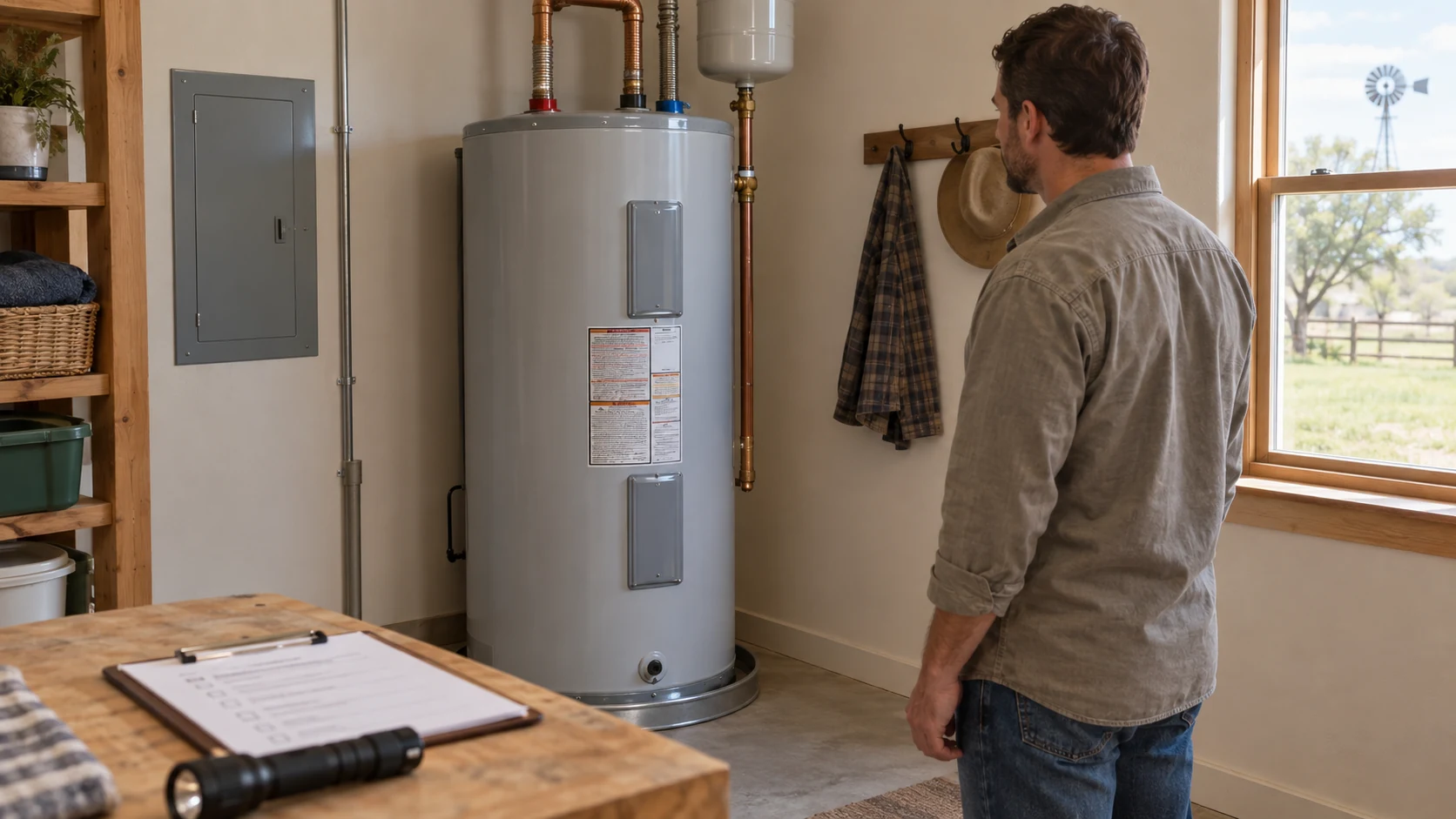
- Water heater problems on the hot side only. If pressure is normal cold and poor hot, the restriction is usually at the heater - a clogged outlet nipple, heavy sediment, or a failing shutoff on the unit. Our water heater service handles sediment, valves, and the connections around the unit, and this case is very common in homes with hard water and older tanks.
- Scale and debris in the lines after work upstream. After a main break or utility work, sediment can travel and lodge in fixtures and supply stops throughout a house.
- A hidden leak. A supply line losing water before it reaches the fixtures reduces what arrives there. This one deserves its own section, because it rarely announces itself and it gets more expensive the longer it runs.
- Corroded galvanized supply piping. A possible cause in older homes, and a restriction that cannot be fixed at the fixture.
- A failing or undersized service line between the meter and the house, or on a private well, an issue with the pump, pressure tank, or pressure switch.
Most Mineral Wells calls that reach us have already had items one through three attempted by the homeowner. That is useful information rather than wasted effort, because it narrows what is left.
Galvanized Corrosion in Palo Pinto County's Older Housing Stock
Where an older Mineral Wells home still has galvanized steel supply piping, internal corrosion is one possible explanation for persistent flow restriction. Identify the actual pipe material and compare measurements before assuming that the age of the home establishes the diagnosis. Some older properties have already been re-piped, while others contain a mix of materials and several generations of repairs.
Galvanized pipe is steel with a protective zinc coating. The coating is sacrificial and it does not last forever. Once it wears through on the inside, the steel beneath begins to rust, and rust occupies far more volume than the metal it came from. Layers of iron oxide build inward from the pipe wall in an uneven, knobby pattern called tuberculation. The result is a pipe whose outside diameter is unchanged but whose inside passage may be closed down to a small fraction of its original bore. Cut a section out of a house that has been on galvanized for decades and the opening left in the middle is often startling.
The consequences follow logically:
- Flow collapses when more than one fixture runs, because the total volume the pipe can pass is small
- Hot side is usually worse than cold, since heat accelerates corrosion and the water heater adds its own sediment story
- Rusty or discolored water appears after the house sits unused, when loose scale has settled and then gets stirred up
- Individual repairs help briefly and then disappoint, because you replaced two feet of a system where the restriction is distributed everywhere
- New fixtures underperform, because the bottleneck is upstream of them
There is a related trap. Replacing a short section of galvanized with copper, without a dielectric separation at the joint, sets up galvanic corrosion right at the transition and can fail faster than the original pipe. Mixed-material repairs done over decades are common in older Mineral Wells homes, and part of what we assess is how many of those transitions are quietly corroding.
Horizontal runs under a pier-and-beam house and the vertical risers inside walls tend to be worst, and the branch lines feeding upstairs or back-of-house bathrooms are usually the first to become unusable, because they are furthest from the entry point and see the most accumulated restriction.
Hidden Leaks as a Pressure Symptom
A leak in a pressurized supply line is a pressure problem before it is a water damage problem. Water escaping upstream of the fixtures means less arriving at them, and in a slab or underground run, the only clues may be indirect for a long time.
Signs worth taking seriously:
- The water meter continues to register with every fixture in the house closed
- Water usage rose with no change in household habits
- A warm spot on a floor, which suggests a hot-side leak under a slab
- Sounds of running water inside a wall or under the floor when nothing is on
- A patch of grass or soil between the meter and the house that stays green or damp in dry weather
- Mildew smell, cupping flooring, or a stain expanding on a ceiling
- On a private well, a pump that starts and stops repeatedly with no water being used
Testing beats guessing here. Our leak detection work uses pressure testing to isolate the section of the system losing water, acoustic detection equipment to hear the signature of a pressurized leak through slab or soil, and non-invasive location to mark the spot before anything is opened. We handle slab leaks, hidden pipe leaks in walls, floors, and ceilings, underground supply lines, hose bibs, and irrigation leaks. The reason for the instruments is simple: the difference between a located leak and a suspected one is the difference between one targeted access point and a series of exploratory openings in a finished house.
A simple test any homeowner can run first: shut every fixture, note the meter reading, wait two hours with nothing used, and read it again. Movement means water is going somewhere.
Historic Downtown Mineral Wells Buildings and Older Fixtures
Mineral Wells' historic downtown adds a layer that houses do not have. Commercial buildings downtown often carry original supply risers serving upper floors, decades of tenant modifications, and fixtures that were installed when the building's use was completely different. Pressure complaints in those buildings usually trace to three things at once: a restricted main riser, branch lines that were extended and reduced in diameter to reach a new location, and fixtures at the top of the building that were always at the edge of what the system could deliver.
Diagnosis in those buildings is about mapping. Where does the service enter, what is the original riser material, which branches were added, and where do the diameters step down? Pressure and flow testing at several points tells us where the restriction sits instead of which floor is complaining loudest.
Older residential fixtures deserve a mention too. Vintage valves, original shower bodies, and old angle stops all contribute restriction, and a homeowner who replaces the visible fixture while leaving a corroded supply stop and a scaled riser in place is going to be disappointed. When we work through pressure complaints as part of general residential plumbing service, we look at the whole path to the fixture, not just the end of it.
How We Diagnose Pressure Loss in a Mineral Wells Home
A real pressure diagnosis in a Mineral Wells home follows a sequence.
- Static pressure at a hose bib with everything closed, to establish what the supply is delivering
- Flow testing with one fixture, then several, to expose restriction that static readings hide
- Comparing hot and cold at the same fixture, to separate heater problems from supply problems
- Comparing fixtures near the entry point against fixtures at the far end of the house, which tells us whether the restriction is distributed or localized
- Checking the meter with everything closed for leak indication
- Inspecting exposed piping in a crawlspace, garage, or utility area to identify materials and look at the condition of joints and transitions
- Where the evidence points to internal restriction, cutting a small sample of pipe at an accessible point, which shows the true remaining bore better than any other test
- On well-fed properties, recording pump behavior and pressure readings; electrical pump controls and pressure-tank settings need a qualified well-system technician
That pipe sample is the moment most conversations become clear. It is difficult to argue with a cross section of pipe whose opening has closed to a fraction of its original size, and it is equally clear when the sample is clean and the problem is elsewhere.
When a Re-Pipe Is the Honest Answer
We do not lead with re-piping, and we do not avoid recommending it when the pipe says so. A partial or full re-pipe is the right call when:
- Cut samples show heavy tuberculation and a badly reduced bore
- Flow collapses whenever two fixtures run, across the whole house rather than one branch
- Repairs to individual sections have produced brief improvement followed by the same complaint
- Discolored water appears intermittently on the hot side, cold side, or both
- The system has accumulated multiple mixed-material transitions from past patches
- Leaks are recurring in different locations, which indicates the whole run has reached the same age and condition
Re-piping is often done in stages. If the kitchen and laundry branch is the worst and the rest of the system was replaced during a past remodel, doing that branch solves the actual complaint. If the entire supply system is original, doing it once is better than paying for the same problem repeatedly in pieces. We provide free estimates on most non-emergency plumbing projects, so getting a real assessment of what your house needs costs nothing, and Iron Horse works under Texas Master Plumber License M-37011 on every job.
Pipe repair and full re-pipe are core residential work for us, and on an occupied home the plan matters as much as the pipe: which fixtures stay in service, how access is made, how walls and floors are opened and closed. We walk through that before starting, not after.
Getting Help With Water Pressure in Mineral Wells
Our Weatherford office at 2319 Tin Top Rd serves Mineral Wells and Palo Pinto County. You can see what we cover locally on the Mineral Wells service area page, and the full list of communities we reach is on our service areas page.
Scheduled service runs Monday through Saturday, 7am to 6pm, with 24/7 emergency service including weekends and holidays for burst pipes, water shutoff, and main line problems. If pressure in your home has fallen off, or you suspect a hidden leak behind it, call (817) 599-8765 and describe the pattern - which fixtures, hot or cold, and whether it changes when something else is running. That pattern usually tells us where to start. More common questions are answered on our FAQ page, and for anything urgent call (817) 599-8765 directly.
Frequently Asked Questions
Why is water pressure low throughout a Mineral Wells house?
Whole-house weakness usually points at something shared rather than a single fixture: a partly closed main valve, a failing pressure reducing valve, a restricted service line, or corroded galvanized supply piping. In Mineral Wells, with many older homes and aging pipe systems, internal corrosion is the most common cause once valves and aerators are ruled out. Testing under flow rather than at rest is what separates these.
Can corroded galvanized pipe be cleaned instead of replaced?
Not in any way that lasts. Corrosion in galvanized pipe is layered rust bonded to the pipe wall, and clearing it removes material the pipe still needs. The remaining wall is thin and prone to pinhole leaks afterward. Where samples show a badly reduced bore, replacing the affected piping is the only fix that restores flow and holds up over time.
How can you tell if a hidden leak is causing low pressure?
Shut every fixture and watch the water meter. If it keeps moving, water is escaping somewhere. Other indicators include a rise in usage without a change in habits, a warm spot on a floor, running water sounds in a wall, or damp ground between the meter and the house. Pressure testing and acoustic detection then pinpoint the location before anything is opened up.
Does the water heater affect water pressure?
It affects the hot side only. If cold pressure is fine and hot is weak at every fixture, the restriction is usually at or near the heater - heavy sediment in the tank, a clogged outlet nipple, or a failing shutoff valve on the unit. If both sides are weak, the heater is not the cause and the problem is in the supply system or the service line.
Do older downtown Mineral Wells buildings have different pressure problems?
Yes. Historic downtown buildings often have an original main riser, branch lines added and reduced in diameter during past tenant work, and older fixtures at upper floors that were always near the limit of what the system could deliver. Diagnosis there is about mapping the path and testing at several points, rather than replacing fixtures on the floor where people are complaining.
How disruptive is a whole-house re-pipe?
It depends on the layout and how much of the piping runs through finished walls versus a crawlspace or attic. We plan the sequence in advance so the household keeps water available where possible, make access at the fewest practical points, and restore what we open. Staging the work by branch is often an option when one section is far worse than the rest.
Topics