A commercial kitchen does not get to close because a floor drain backs up during a dinner rush. That fact shapes every plumbing decision a restaurant or retail food operator in Hudson Oaks makes: what gets maintained on a schedule, what gets deferred, who you call at nine at night, and how much line capacity you are quietly giving away to grease every week. Hudson Oaks sits on the I-20 corridor with a dense mix of retail businesses and residential neighborhoods, which means high-traffic food service on tight footprints, shared laterals, and health inspections that do not care how busy the week was. This is a working guide for owners and managers: what fails in commercial kitchen plumbing, why it fails in that order, and how to get the work done while the doors are closed.
The Grease Load Problem, Stated Honestly
Every commercial kitchen produces fats, oils and grease at a rate no residential line was designed to handle, and a commercial line only copes because something upstream is catching most of it. Fryer oil is the obvious source, but the volume that reaches the drains comes from ordinary work: rinsing sheet pans, wiping a flat top into a floor sink, washing dishes with hot water that carries emulsified fat past the sink and into the line.
That is the mechanism worth understanding. Grease leaves your kitchen as a warm liquid and arrives in your lateral as a solid. It cools, adheres unevenly to the top and sides of the pipe, and builds a rough surface that catches food solids, starches and paper. A thin film becomes a ring, the ring narrows the pipe, and a line that once carried peak dish-pit flow with room to spare now runs at capacity on a normal Friday. The backup happens months later, on your busiest service, which is why it always feels sudden and never is.
The operational signals that your line is narrowing, in the order they usually appear:
- A floor drain in the dish area gurgles or drains slowly at peak volume but clears when the kitchen is quiet.
- The mop sink takes noticeably longer to empty than it did last quarter.
- An odor rises from floor drains in the afternoon, especially in summer, because a slow line lets solids sit and a partially blocked trap can lose its seal.
- Two fixtures act up together, which almost always means the shared branch or the main, not the fixture.
- A backup appears at the lowest drain in the building, which is where a main line blockage shows itself first.
By the time the fourth or fifth item on that list is happening, the line is already substantially restricted. The goal of a maintenance program is to never get past the first.
Grease Traps and Interceptors: Installation, Cleaning and Repair
A grease trap or interceptor is a settling device. Wastewater enters, velocity drops, fats and oils float to the top, solids sink to the bottom, and relatively clear water in the middle passes out to the sewer. It works well when it is sized right, plumbed right and pumped on a sensible interval. It stops working in specific and predictable ways.
Undersizing. A trap sized for a menu you no longer serve, or for a kitchen that has since added a fryer and a second dish station, does not have the retention time to let grease separate. Water moves through too fast and carries grease straight into the lateral. The trap looks like it is working and is not. If your service interval keeps getting shorter and your line still fouls, undersizing is a leading suspect.
Overdue pumping. As the grease cap thickens and the solids layer builds, the effective volume shrinks, retention time drops, and separation quality falls off a cliff. A trap that is more than about a quarter full of grease and solids by depth is no longer protecting the line, no matter what the schedule on the wall says.
Baffle and tee damage. Interior baffles and inlet and outlet tees are what force the flow to slow and turn. When a baffle corrodes, cracks or gets knocked loose during cleaning, the trap short-circuits. Wastewater takes the straight path from inlet to outlet and separation stops entirely. This is invisible from the top unless someone looks, and it is one of the most common things we find on a trap that "is being cleaned regularly" but is not protecting anything.
Lid, frame and gasket failure. On an exterior in-ground interceptor, a failed lid seal means odor, insects and stormwater intrusion, and a corroded frame is a safety issue in a parking area.
Improper connections. We still find kitchens where a fixture that should be routed through the trap, commonly a prep sink or a wok station added during a remodel, bypasses it entirely. Every gallon through that fixture goes to the lateral unprotected.
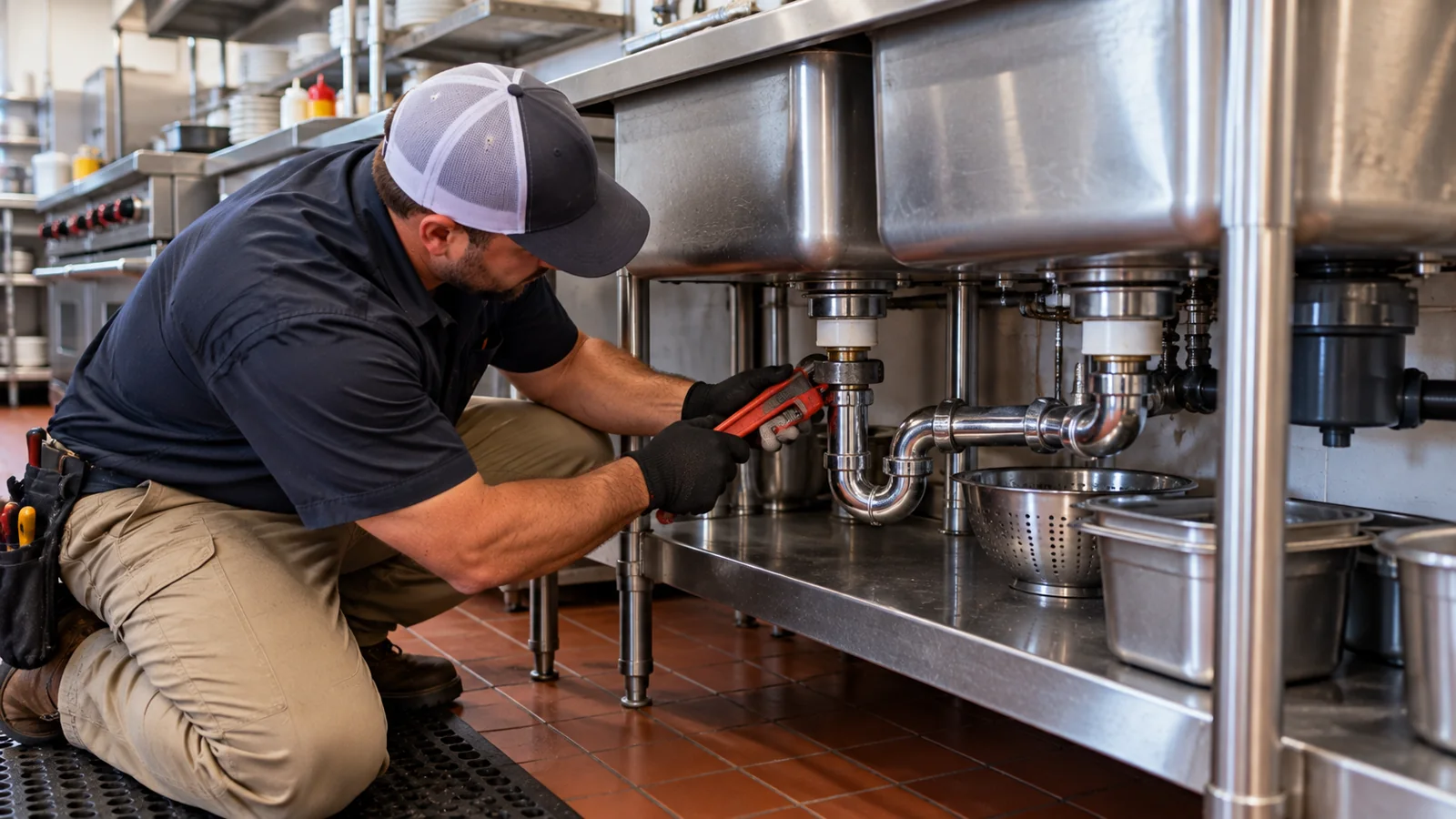
We handle grease trap installation, cleaning and repair as part of our commercial plumbing services, along with the rough-in work for build-outs, tenant improvements and new construction that determines whether the next operator in that space inherits a good system or a bad one.
Keep your service records current and accessible. Inspectors ask, and the difference between a clean inspection and a finding is often whether the log is at hand. Keep dates, volume removed and repairs in one place.
Why Hydro-Jetting Is the Right Tool for Kitchen Lines
There is a real technical difference between snaking a line and jetting it, and in a commercial kitchen it matters more than anywhere else.
A cable machine bores a hole. It punches through the blockage and restores flow, which feels like a fix because the water goes down again. But the grease ring lining the pipe wall is still there, the pipe is still narrowed, and you have bought weeks or days before the next backup arrives at a worse moment.
Hydro-jetting scours. High-pressure water directed at the pipe wall cuts accumulated grease, soap, starch and sludge off the pipe and flushes it downstream, returning the line to close to its original inside diameter. When the failure mode is wall accumulation rather than a discrete object, that is the only method that resolves the underlying condition.
Where we jet in a commercial kitchen:
- Kitchen floor drains and floor sinks, which collect the heaviest mixed load of grease and solids.
- Mop sink drains, which take detergent, mop debris and grease film in a combination that builds fast.
- Dish-pit and three-compartment sink branch lines.
- The main line out to the tap, which is where accumulated restriction from every branch shows up.
We follow the work with a camera. A post-clean video inspection is how you know the jetting actually cleaned the pipe rather than just clearing the immediate blockage, and it is also how we catch the structural problems that jetting cannot fix: a bellied section holding standing water, a cracked or offset joint, root intrusion from the landscaping in the parking island, or a length of pipe whose interior has degraded past cleaning. Our drain cleaning service includes hydro-jetting, kitchen drains and disposals, floor drains, main line clearing and post-clean camera verification, and we run preventive maintenance programs for restaurants and commercial kitchens specifically.
A word on chemical drain products in a commercial setting: they rarely clear a deep grease blockage, they can corrode pipe, and they create a hazard for the next person who opens that line. In a kitchen with a schedule to keep, they usually cost you time rather than save it.
When the Problem Is the Sewer Line, Not the Drain
Some Hudson Oaks issues are not kitchen issues at all. Retail and restaurant buildings along the I-20 corridor frequently sit on laterals that are decades old, sometimes shared across a multi-tenant building, and sometimes running under a parking lot that has been resurfaced twice since anyone last thought about what is under it.
Signs the problem is downstream of your kitchen:
- Multiple unrelated fixtures back up together, including restrooms.
- Wastewater surfaces at a cleanout in the parking area.
- Jetting restores flow, but the line fouls again far sooner than kitchen load explains.
- A neighboring tenant reports the same trouble the same week.
The diagnostic is an HD camera inspection of the lateral. It tells us the material, the condition, the slope, and the exact location and depth of any defect. From there the options are honest and finite: mechanical cleaning and root cutting with root-inhibiting treatment where intrusion is the issue, trenchless repair using pipe lining or pipe bursting where the pipe run is structurally compromised but the path is usable, or full replacement where it is not. Our sewer line work covers camera inspection, hydro-jetting, root intrusion treatment, trenchless pipe lining and pipe bursting, full replacement and cleanout installation.
Trenchless matters for a business with a parking lot and a storefront. Lining or bursting a lateral avoids trenching the length of the drive, which is the difference between a disruption customers notice and one they do not. It is not right for every line, and we will say so when condition or geometry rules it out.
If your building does not have an accessible exterior cleanout, adding one is one of the highest-value small improvements you can make. It turns future service calls into exterior work instead of dragging equipment through your kitchen during business hours.
Backflow Preventer Installation and Annual Testing
Backflow prevention is where plumbing and health code meet most directly, and it is the item most likely to be sitting quietly out of compliance in a food service building.
The device exists to stop water from your building from reversing into the public supply during a pressure drop. In a commercial kitchen the cross-connection risks are everywhere: hose bibs with chemical dispensers, carbonation systems, dish machines, mop sinks, ice machines, irrigation, and any fixture with a hose that can end up sitting in a sink of dirty water. A backflow assembly is a mechanical device with internal seals and check valves, and those parts wear. A device that passed two years ago can fail today without any visible change.
Confirm the testing interval and reporting requirements with the serving water supplier. Required testing must be performed by a qualified tester using appropriate equipment. The test verifies that each check valve holds against reverse flow and that the relief valve opens at the correct differential. It either passes or it does not, and a failed test means repair or replacement before the device is back in service.
We install backflow preventers and handle the annual testing as part of our commercial work, and we keep the documentation straight so it is there when it is asked for. If you have taken over an existing Hudson Oaks space, the two questions worth asking this week are: where is our backflow assembly, and when was it last tested? A surprising number of operators inherit a building without knowing either.
Water Heating for Commercial Kitchens
A commercial kitchen lives and dies on hot water availability, and the water heating system is usually the second thing to cause an unplanned closure after drains.
The issues we see:
- Recovery rate too low for the real duty cycle. Tank volume looks adequate on paper, but during a dish-pit push the heater cannot reheat as fast as the kitchen draws and sanitizing temperature drifts. That is a sizing problem, not a broken part.
- Sediment accumulation. Hard water drops mineral out of solution inside the tank. The layer insulates the burner, cuts capacity, causes the rumbling sound and shortens the heater's life.
- Failed or unmonitored temperature and pressure relief valves, which are a safety item, not a maintenance nicety.
- No redundancy. A single heater serving an entire kitchen means a single failure closes the kitchen.
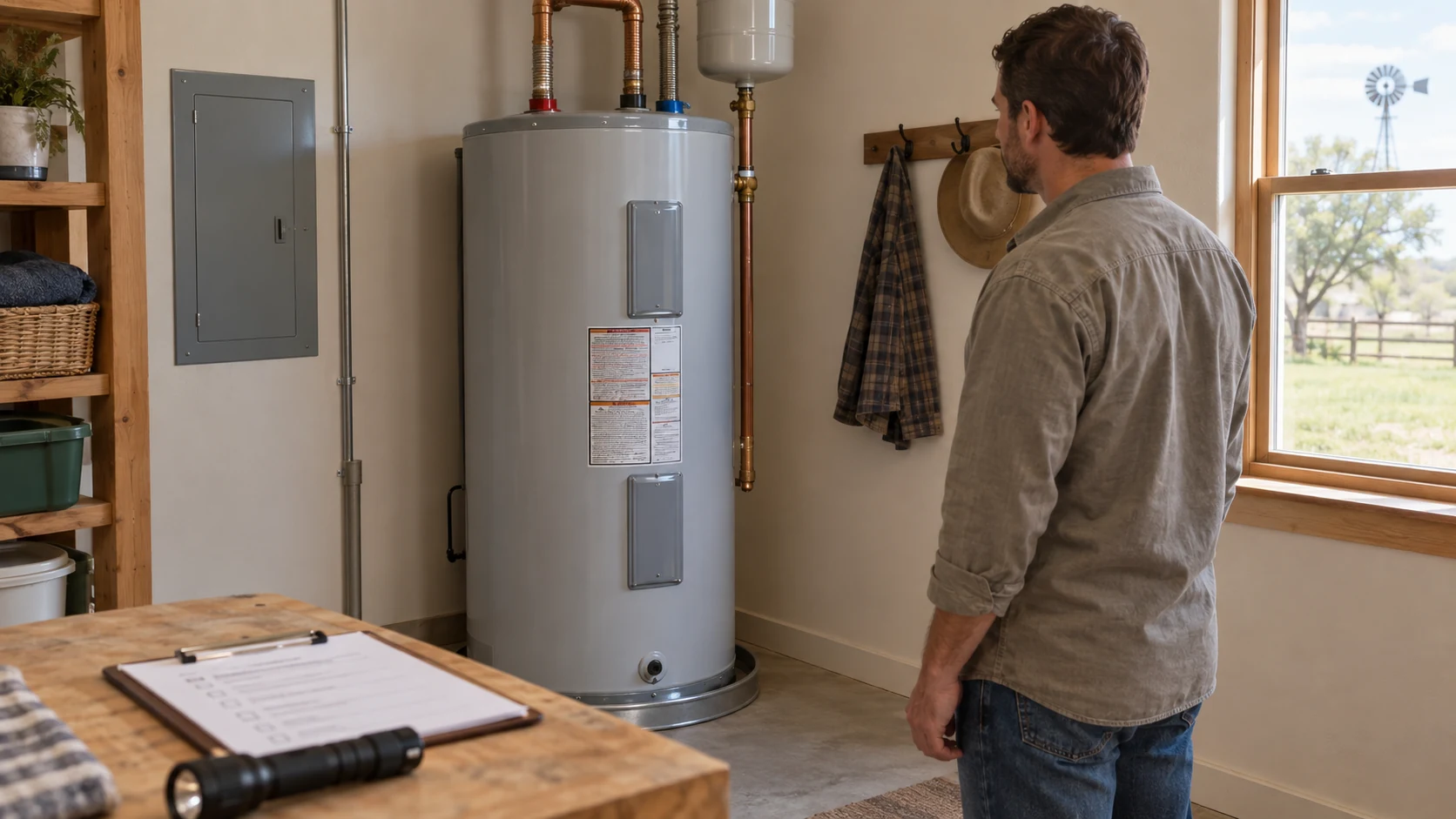
We work on high-capacity tank and tankless commercial systems, including replacement with correct sizing, code-compliant connections and removal of the old unit. Our water heater service covers repair of heating elements, thermostats, anode rods, relief valves and sediment issues as well as replacement and tankless installation, on all major brands of tank and tankless equipment.
The scheduling advice here is simple: a heater showing capacity loss, rumbling or a weeping relief valve is telling you it is going to fail. Replacing it on a Monday morning before opening is a routine job. Replacing it at seven on a Saturday evening is not.
Building a Maintenance Schedule That Fits a Hudson Oaks Kitchen
The businesses that never call us in a panic are the ones running on a calendar rather than on symptoms. A reasonable framework for a Hudson Oaks kitchen:
- Weekly, in-house: clean floor sink strainers and baskets, check that floor drains flow freely at peak, and confirm nobody is pouring fryer waste down a drain. That last one is a training issue and the biggest lever an operator controls.
- Monthly, in-house: measure and log grease trap depth if the unit allows it, and check under the dish machine and prep sinks for slow drips.
- Quarterly or on a load-based interval, professional: trap pumping plus inspection of baffles and tees. Your own records set the right interval better than any general rule.
- Semi-annual to annual, professional: hydro-jetting of kitchen floor drains, mop sink lines and the main, with camera verification.
- Annual, professional: backflow preventer testing, water heater inspection including relief valve and sediment check, and a camera look at the lateral if the building has a history.
The value of the schedule is not just avoiding backups. It is that all of this work can be done between close and open, on a day you choose. Emergency work happens on the failure's schedule, in the middle of service, in front of customers.
Working With Iron Horse in Hudson Oaks
We are Iron Horse Mechanical and Plumbing Services, a locally owned, licensed and insured Texas plumbing contractor serving this area since 2014 under Texas Master Plumber License M-37011. Our Weatherford office at 2319 Tin Top Rd handles Parker County commercial work, and Hudson Oaks businesses along the I-20 corridor are a regular part of that route.
For commercial clients we schedule around service. Scheduled work runs Monday through Saturday, 7am to 6pm, and we provide 24/7 emergency service including weekends and holidays, which is what matters when a main line backs up on a Saturday night. We also provide free estimates on most non-emergency projects, so planning a jetting program or a build-out rough-in starts with a clear scope rather than a guess.
You can read customer experiences on our reviews page, and our Hudson Oaks service area page describes the residential and commercial plumbing work available locally. Reviews provide context, not a promise of the timing or results for another property.
To put a maintenance program in place, get a grease trap inspected, or schedule jetting before your next busy season, call our Weatherford office at (817) 599-8765. For a backup, a failed heater or a line problem that is stopping service right now, call the same number, (817) 599-8765, and ask for emergency dispatch.
Frequently Asked Questions
How often should a Hudson Oaks restaurant have its grease trap cleaned?
It depends on trap size and grease load, not on a universal calendar. The working standard is to service before the combined grease and solids layer reaches about a quarter of the trap's depth. High-volume kitchens with fryers often need it quarterly or more often, lighter menus less. Track your own measurements and let the data set the interval.
Is hydro-jetting better than snaking for a commercial kitchen line?
For grease, yes. A cable bores a hole through the blockage and leaves the grease ring on the pipe wall, so the line refouls quickly. Jetting scours the wall and restores close to the original inside diameter, which is what actually buys you months instead of days. We verify the result with a post-clean camera inspection.
How often does a backflow preventer need to be tested in Texas?
Confirm the required interval with your water supplier and the type of assembly installed; an annual test is commonly part of commercial maintenance planning. A qualified tester checks the assembly's performance and provides the required record. A failed test needs assessment and corrective action, not a visual inspection alone. Keep the latest report with the property's maintenance records.
Can plumbing work be done after hours so we do not close the kitchen?
Call to discuss the work, operating schedule, and available service windows before assuming an overnight appointment. Scheduled service is Monday through Saturday, 7am to 6pm. Emergency plumbing is available 24/7, including weekends and holidays, but that does not make every planned maintenance task an after-hours service. The office can confirm what is possible for your kitchen.
What causes a slow floor drain in a commercial kitchen in Hudson Oaks?
Most often, grease and solids built up on the pipe wall downstream of the drain, which narrows the line until it cannot carry peak flow. Other causes include a failed or bypassed grease trap, a bellied section holding water, root intrusion in the exterior lateral, and a partially blocked main. A camera inspection tells us which one it is.
Do you handle plumbing rough-in for a new restaurant build-out?
Yes. We handle rough-in for build-outs, tenant improvements and new construction, including grease trap installation, floor drains and floor sinks, mop sink and dish-pit lines, backflow prevention and high-capacity water heating, all to Texas code. Getting sizing and routing right at rough-in is what keeps a kitchen out of trouble for the life of the lease.
Topics